

February 15, 2026
Coach G
No Comments
By Coach G | February 2026 | 9 min read
———
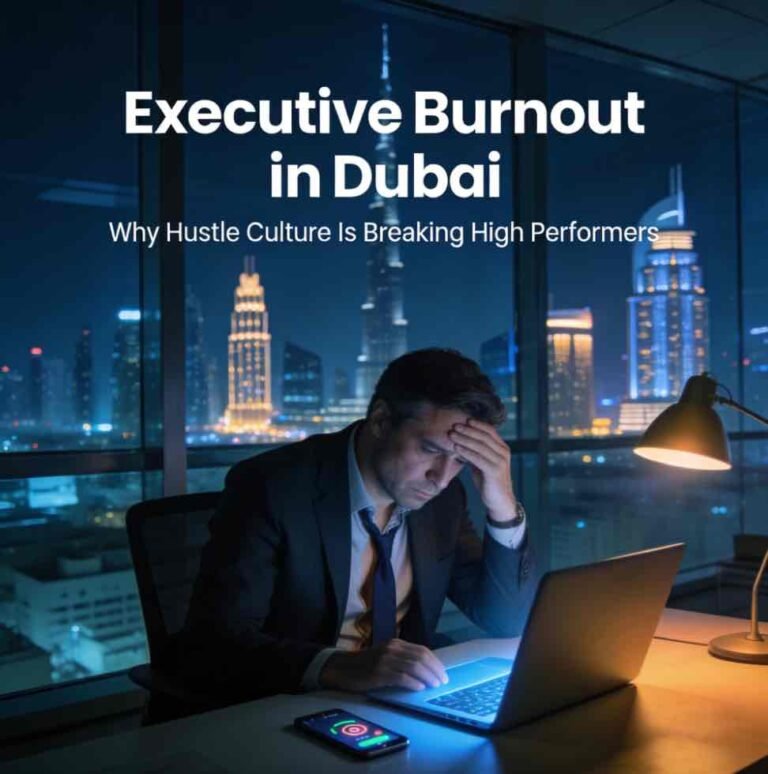
You haven’t taken a proper day off in three months. You wake up tired. You go to bed wired. Somewhere between the 7am gym session that’s supposed to fix everything and the 11pm email you told yourself you wouldn’t check, you’ve lost the ability to feel anything but a dull hum of obligation.
You’re not lazy. You’re not weak. You’re burned out. And in Dubai, you’re not alone.
This city was built by ambition. But ambition without an off-switch doesn’t produce excellence , it produces executives who are high-functioning on the outside and slowly collapsing on the inside.
The Numbers Dubai Doesn’t Talk About
Let’s start with what the data actually says, because the scale of this problem is staggering.
| 89% | of UAE professionals report feeling “always on” — far higher than the global average of 67%. Cigna Healthcare Vitality Study 2024/2025 (UAE Edition) |
| 99% | of UAE residents report at least one burnout symptom in the past year. Cigna Healthcare Vitality Study 2024/2025 (UAE Edition) |
| 78% | of decision-makers identify work stress and burnout as a top organisational risk. International SOS Risk Outlook 2025 |
| 80% | of middle managers rank burnout as their single highest concern — above cyberattacks. International SOS Risk Outlook 2025 |
Read those numbers again. Ninety-nine percent. That’s not a trend. That’s a crisis hiding in plain sight behind designer suits and luxury car leases.
Why Burnout Hits Harder in Dubai
Burnout exists everywhere. But Dubai has a specific cocktail of conditions that makes it more intense, more invisible, and harder to escape than almost any other city.
The golden cage effect
A tax-free salary, company housing allowance, school fees covered, annual flight tickets home. You’re earning more than you would anywhere else in the world , and that creates a powerful gravitational pull that keeps you in a situation long after your body and mind have started sending distress signals.
You can’t walk away because the financial architecture of your life in Dubai doesn’t exist elsewhere. So you stay. You push through. You tell yourself “just one more year.” And the burnout compounds.
Performance is identity
Dubai rewards visible success. The car you drive, the building you live in, the brunch you’re seen at , they’re not just lifestyle choices, they’re social currency. When your identity is fused with your performance, slowing down feels like disappearing. Resting feels like falling behind. And admitting you’re struggling feels like social death.
This is why so many executives in this city are exhausted but can’t stop. They’re not addicted to work. They’re addicted to the version of themselves that work creates.
The expat isolation multiplier
You’re thousands of miles from your family. Your closest friends leave every two to three years. The social connections you do have are often transactional , networking events, business dinners, gym buddies who know your bench press but not your fears.
When burnout hits in a city where deep, enduring relationships are rare, there’s often nobody to notice. Nobody to say “you don’t seem like yourself.” Nobody to catch you before you crash.
The “always on” infrastructure
Dubai operates across time zones. Your clients are in London, your team is in Singapore, your boss is in New York. There is no natural end to the workday. WhatsApp groups ping at midnight. Emails arrive at 5am. The expectation of availability is baked into the culture —, and it’s corrosive.
The Cigna study found that the percentage of UAE professionals who felt “always on” actually increased year over year, from 88% to 89%. The trend is going in the wrong direction.
Burnout Is Not What You Think It Is
Most people think burnout means you’re tired. That’s exhaustion. Burnout is something different and much more dangerous.
The World Health Organisation classifies burnout as an occupational phenomenon characterised by three dimensions:
Emotional exhaustion: You’re depleted. Not just physically tired, but emotionally empty. Things that used to excite you feel like obligations. You go through motions that used to have meaning.
Depersonalisation: You become cynical. Detached. You start viewing colleagues, clients, even family members as demands on your energy rather than people you care about. You notice a hardness in yourself that wasn’t there before.
Reduced personal accomplishment: Despite continuing to perform, you feel like nothing you do matters. The wins don’t register. The recognition feels hollow. You’re achieving on autopilot while internally questioning the point of all of it.
This is why burnout is so dangerous for high performers specifically. You can be burned out and still hitting your targets. You can be burned out and still getting promoted. The performance hides the decay. By the time it shows up in your numbers, the internal damage has been compounding for months or years.
What Burnout Is Actually Costing You
The costs of executive burnout extend far beyond feeling tired. Here’s what’s silently eroding while you push through:
Your health
Burnout has been linked to a significantly increased risk of cardiovascular disease, higher stroke risk, depression, and a substantially elevated risk of Type 2 diabetes. Your body keeps a score that your mind is trying to override. The cortisol that helped you push through that quarterly deadline is the same cortisol that’s slowly degrading your immune system, your sleep quality, and your cardiovascular health.
Your relationships
When you’re running on empty, you have nothing left to give. Your partner gets the worst version of you , the irritable, distracted, emotionally unavailable version. Your children get presence without attention. Your friendships become the first thing you sacrifice because “there’s no time.”
I’ve worked with executives whose marriages were on the edge of collapse , not because of infidelity or fundamental incompatibility, but because burnout had turned them into ghosts living in the same house.
Your decision-making
Sleep deprivation and chronic stress destroy your capacity for nuanced thinking. You default to binary decisions. You become reactive instead of strategic. The irony is devastating: the harder you push, the worse your judgment gets, which creates more problems, which requires more pushing. It’s a doom loop disguised as dedication.
Your career trajectory
Burned-out leaders eventually make a catastrophic error , a blown negotiation, a tone-deaf email, a decision made from depletion rather than clarity. Or they simply leave, taking their institutional knowledge with them. Research suggests replacing a senior executive costs well over double their salary when you factor in recruitment, onboarding, lost relationships, and momentum.
Why the Standard Solutions Don’t Work
You already know the standard advice. Take a holiday. Meditate. Exercise. Delegate more. Set boundaries.
And you’ve probably tried most of it. Here’s why it hasn’t worked:
Holidays treat symptoms, not systems. You feel better for a week in the Maldives. By Tuesday of your first week back, you’re back to baseline. That’s because a holiday changes your environment. It doesn’t change the operating system that burned you out in the first place.
Meditation helps but doesn’t reprogram. Mindfulness is a powerful tool for awareness. But awareness of a pattern is not the same as changing it. You can sit with your stress in full consciousness and still be driven by the same subconscious beliefs about your worth, your safety, and what happens if you slow down.
Boundary-setting fails when your identity is the problem. You can’t set boundaries you don’t believe you deserve. If your operating system is coded with “my value equals my output,” every boundary feels like a threat to your identity. You’ll set them and then immediately violate them because the deeper programme overrides the conscious intention.
Traditional therapy provides insight but not installation. A therapist can help you understand that your burnout pattern originates in a childhood where love was conditional on achievement. That’s valuable. But understanding the origin of the code doesn’t delete it. You need a different kind of intervention — one that works at the level where the pattern actually lives.
What Actually Works: Reprogramming the Operating System
Here’s what I’ve learned from 15 years of working with burned-out executives across four continents: burnout is never just about workload. It’s always about identity.
The executives who burn out are the ones whose sense of self is wired to their performance. Their nervous system has learned that rest is dangerous, that slowing down means falling behind, that they are only as valuable as their last quarter’s results. These aren’t conscious beliefs. They’re subconscious programmes — installed in childhood, reinforced by decades of achievement culture, and locked in place by a nervous system that genuinely believes survival depends on never stopping.
You can’t overcome that with a to-do list and a meditation app.
The R.I.S.E.™ Method was built specifically for this pattern. Here’s how it maps to burnout recovery:
REVEAL: We uncover the specific beliefs driving your burnout. Not generic “work-life balance” advice — the exact subconscious code that makes rest feel threatening and output feel like oxygen.
INTEGRATE: We process the emotional material underneath. The grief of a childhood where love was earned. The anger at a system that rewards self-destruction. The fear of what you’d be without the title. This isn’t comfortable. It’s necessary.
SHIFT: Using neuroscience-backed subconscious reprogramming, we rewire your nervous system to feel safe in stillness, to decouple your identity from your output, and to replace “I must perform to be worthy” with “I am worthy, and my performance flows from that.”
EMBODY: You become someone who naturally operates from a place of calm power rather than anxious drive. Not because you’re forcing new habits. Because the person you’ve become doesn’t need to grind to feel safe. The transformation is structural, not performative.
This isn’t about working less. It’s about operating from a fundamentally different place — one where high performance and inner peace are not in conflict.
What This Looks Like in Practice
“This isn’t coaching. It’s an operating system upgrade. I went from burnt out and anxious to calm and magnetic. My team noticed before I did. Now I lead from a place of power, not pressure.”
— David K., CEO, Abu Dhabi
David came to me running a company of 200 people and sleeping four hours a night. His board was happy. His numbers were strong. His marriage was falling apart and he’d started having chest pains he was ignoring. Within eight sessions, his team independently reported that he was “a different person.” He didn’t change his job. He changed the operating system running it.
———
Recognise Yourself in This?
If you read this article and something landed — if you felt that uncomfortable recognition of your own patterns , that’s not a problem. That’s data. And it’s the first step.
The free 30-minute assessment is designed to cut through the noise. We’ll identify what’s actually driving your burnout (not the surface story, the source code), and map whether the R.I.S.E.™ Method is the right intervention. If it’s not, I’ll tell you what is.
➡ Book Your Free Assessment at coach-g.com
———
Frequently Asked Questions
How do I know if I’m burned out or just stressed?
Stress is temporary and situation-specific — a big deadline, a difficult client, a rough week. When the stressor resolves, you recover. Burnout is chronic, cumulative, and doesn’t resolve with rest. If you’ve taken a holiday and come back feeling just as depleted within days, if things that once excited you now feel like obligations, or if you’re performing well but feeling nothing — that’s burnout territory.
Can I recover from burnout without quitting my job?
Absolutely. Most of my clients don’t leave their roles. They transform how they operate within them. The goal isn’t to escape your career — it’s to change the internal operating system that turned a career you chose into a cage you can’t escape. When the code changes, the same job can feel entirely different.
How long does burnout recovery take with coaching?
Faster than you’d expect. Traditional burnout recovery through rest and lifestyle changes alone can take six months to a year. The R.I.S.E.™ Method works at the subconscious level where burnout patterns are installed, which means measurable shifts typically begin within 4–6 weeks. Full transformation — where colleagues notice before you do — usually happens across 8–12 sessions.
Is burnout coaching covered by insurance in Dubai?
Life coaching is not typically covered by health insurance in the UAE. However, many clients find that the ROI far exceeds the investment — in preserved health, saved relationships, improved decision-making, and career longevity. Some corporate clients expense coaching through their L&D or executive development budgets.
What’s the difference between burnout coaching and therapy for burnout?
Therapy for burnout focuses on processing the emotional and psychological damage — understanding what led to this state and developing coping strategies. Burnout coaching through R.I.S.E.™ focuses on reprogramming the identity-level patterns that caused the burnout in the first place. Therapy asks “why did this happen?” Coaching asks “how do I rewrite the code so it doesn’t happen again?” They’re complementary, not competing.
———
About Coach G
Coach G is Dubai’s expert life coach for executives and high-achievers, with 15+ years of experience transforming lives across four continents. Creator of the R.I.S.E.™ Method (Reveal • Integrate • Shift • Embody), Coach G combines quantum psychology, Jungian depth work, neuroscience, and NLP to deliver identity-level transformation in weeks, not years. Executive MBA. 500+ lives transformed.
Share:
Categories
Popular Posts



Tags
Book Summary
Coach G
Coaching
consciousness
ego
Emotional Healing
Emotional Intelligence
Emotional Resilience
empowerment
faith
forgiveness
Growth Mindset
healing
Inner Peace
law of attraction
letting go
life coach
life coach Dubai
Life Coaching
Life Coaching Dubai
Manifestation
marriage
Mental Health
Mindfulness
Mindset Shift
oneness
Personal Development
personal growth
Personal Transformation
Positive Mindset
productivity
quantum psychology
relationships
Resilience
Self-Awareness
Self-Discovery
Self-Improvement
Spiritual Awakening
spiritual coach
spiritual growth
spirituality
Success Mindset
Time Management
Transformation
Universal Laws
© 2026 Coach G Dubai. All rights reserved.


