

February 27, 2026
Coach G
No Comments
On the Inner Architecture of Belonging
By Coach G
6 min read
The World Health Organization has declared loneliness a global public health crisis. The United States Surgeon General has issued an advisory comparing its health effects to smoking fifteen cigarettes a day.
Studies now link chronic loneliness to inflammation, cardiovascular disease, cognitive decline, and a mortality risk that rivals obesity. The world has noticed. And the world’s response, predictably, has been to prescribe more connection: more community events, more social apps, more initiatives to “bring people together.”
But what if the epidemic is not about a lack of connection at all? What if the deepest loneliness is not the absence of other people, but the absence of yourself?
The Paradox of the Hyperconnected Age
We have never been more reachable and less reached. The average person checks their phone ninety-six times a day.
They have hundreds of followers, dozens of group chats, and access to anyone on the planet through a screen. And yet, the data is unambiguous: people are lonelier now than at any point in recorded history. This is not a coincidence. It is a consequence.
Because connection without presence is not connection. It is performance. And most of what we call “socializing” in the modern world is exactly that: curated self-presentation exchanged at high speed, leaving both parties more isolated than when they began.
The Sufi poet Rumi understood this eight centuries ago when he wrote that the wound is the place where the light enters you. But we have become a civilization obsessed with covering our wounds rather than entering them. We scroll instead of sitting. We broadcast instead of listening. We accumulate followers instead of cultivating intimacy. And the loneliness deepens.
The Inner Disconnection
Here is the part that no public health campaign will tell you: you cannot be truly lonely if you are truly in relationship with yourself. This is not a platitude. It is a psychological reality rooted in decades of attachment theory, depth psychology, and contemplative wisdom.
When you are disconnected from your own inner life, from your emotions, your body, your unconscious, you become dependent on external validation to feel real. Other people become mirrors you need in order to see yourself. And when those mirrors are unavailable, distorted, or insufficient, the emptiness is not just uncomfortable. It is existential.
Jung described this as the loss of relationship with the Self, the deeper, organizing center of the psyche that holds the totality of who you are. When we lose contact with this inner center, no amount of outer connection can fill the void. We become, as he put it, like a person without a shadow: moving through the world but never quite landing.
The Nervous System Knows First
Modern neuroscience has given us a language for what the mystics always intuited: loneliness is not just a thought. It is a physiological state. Stephen Porges’ Polyvagal Theory reveals that our nervous system is constantly scanning the environment for cues of safety and danger, a process he calls neuroception.
When the nervous system perceives chronic disconnection, it shifts into a state of dorsal vagal shutdown: a collapse response characterized by numbness, fatigue, withdrawal, and a sense of being “behind glass.” This is the loneliness that people describe as feeling hollow, like watching your own life from a distance.
And critically, this state does not resolve simply by being around other people. If your nervous system is locked in a protective shutdown, a room full of friends can feel as isolating as an empty apartment. The body must feel safe before it can feel connected. And that safety begins, always, with the relationship between you and your own nervous system.
The Ancient Wisdom of Solitude
Every serious wisdom tradition draws a clear distinction between loneliness and solitude. Loneliness is the pain of unwanted disconnection. Solitude is the practice of chosen presence with oneself.
The Desert Fathers of early Christianity sought the wilderness not to escape community but to build the inner foundation that makes real community possible. The Hindu concept of viveka, spiritual discernment, requires the practitioner to withdraw from external stimulation long enough to hear the voice beneath the noise.
In the Hermetic tradition, the principle of correspondence teaches that the outer world reflects the inner world: “As within, so without.” If your inner landscape is one of fragmentation, avoidance, and self-abandonment, your outer relationships will inevitably mirror that chaos, no matter how many connections you accumulate. The ancient prescription was never more socializing. It was deeper self-knowledge.
Dubai and the Loneliness Paradox
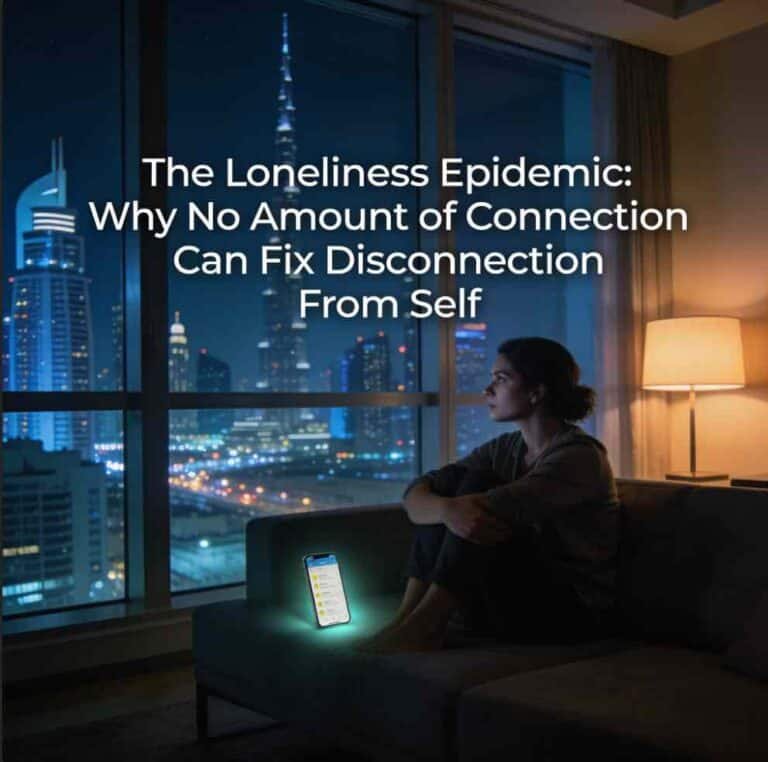
I write this from Dubai, a city that embodies the paradox of modern loneliness with almost poetic precision. This is one of the most connected cities on earth. It is cosmopolitan, ambitious, beautifully engineered for gathering. Brunch culture, networking events, coworking spaces, and social clubs proliferate.
And yet beneath the surface, many of the people I work with describe a particular kind of aloneness: the loneliness of being surrounded by transience, of building relationships in a place where everyone might leave, of performing success in a city that rewards the exterior while leaving little room for the interior.
This is not a criticism of Dubai. It is an observation about what happens when a culture is built around acceleration without an equal emphasis on reflection. The city becomes a mirror for the broader human condition: we can build the most spectacular outer world imaginable and still feel empty inside if we have not built an inner one to match.
Why Self-Help Gets This Wrong
The conventional advice for loneliness follows a predictable script: join a club, volunteer, put yourself out there, be vulnerable. And none of this is wrong, exactly. But it misses the foundational issue entirely.
If you are disconnected from yourself, if you have abandoned your own emotional life, if you have spent years performing a version of yourself that others find acceptable rather than inhabiting the version that is real, then “putting yourself out there” simply puts the performance out there. You connect mask to mask. And you wonder why it still feels hollow.
Real belonging requires first belonging to yourself. It requires what the psychoanalyst Donald Winnicott called “the capacity to be alone”: the ability to exist in your own presence without anxiety, without distraction, without the compulsive need to be seen.
This capacity is not innate for most of us. It is built. And it is built through the slow, unglamorous work of returning to yourself again and again, through stillness, through honest self-inquiry, through the willingness to feel what you actually feel rather than what you think you should feel.
The Physiology of Reconnection
If loneliness lives in the body, and the research is clear that it does, then reconnection must also begin in the body. This is not abstract philosophy. It is practical neuroscience.
Vagal tone, the measure of your vagus nerve’s capacity to regulate your stress response, is directly correlated with your ability to feel safe in connection. People with low vagal tone, often the result of early attachment disruption, chronic stress, or trauma, find social engagement physiologically costly. Their nervous system experiences connection as a threat rather than a resource.
The path back begins with what somatic practitioners call “bottom-up” regulation: breathwork, humming, cold exposure, gentle movement, and the slow cultivation of interoceptive awareness, the ability to feel what is happening inside your own body.
The ancient yogis knew this. The Stoics practiced it through daily cold baths and controlled breathing. Modern science has simply confirmed what embodied traditions have taught for millennia: you cannot think your way out of loneliness. You must feel your way back.
Toward a New Understanding
The loneliness epidemic is real, and it deserves our attention. But if we treat it only as a social problem, as a deficit of community that can be solved by engineering more contact, we will fail.
Because loneliness, at its root, is a spiritual and psychological condition. It is the consequence of a civilization that has optimized for everything except inner life. It is what happens when we build entire identities around productivity, performance, and approval, and then wonder why we feel unseen.
The antidote is not more connection. It is deeper connection, beginning with the most neglected relationship in most people’s lives: the one with themselves.
When that relationship is restored, when you can sit in your own presence and feel at home, something remarkable happens. The desperate need for external validation softens. The compulsive scrolling slows. The performative socializing gives way to genuine intimacy. Not because you no longer need people, but because you no longer need them to complete you.
The Invitation
Before you add another social event to your calendar, before you download another app designed to connect you with strangers, try this: sit alone for twenty minutes. No phone. No music. No guided meditation telling you what to feel. Just you, in your own company, with whatever arises.
Notice the discomfort. Notice the urge to reach for something. And then, stay. Stay with yourself the way you would stay with someone you love who is in pain. Because that is exactly what you are doing.
The loneliness epidemic will not be solved by more connections. It will be solved by more presence. And presence, like all things worth having, begins at home.

MEET COACH G.
I help individuals like you reprogram your mind, break free from subconscious limitations, and expand your awareness to create lasting transformation. Your consciousness shapes your reality—when you shift your perception, you unlock new levels of success, resilience, and fulfillment effortlessly. Blending Quantum Psychology, Ancient Wisdom, and cutting-edge neuroscience, I guide you through deep transformation—helping you dissolve mental barriers, rewire old patterns, and step into a life of clarity and limitless potential. Based in Dubai & available online, I’m here to help you harness the power of your mind and reshape your reality.
Share:
Categories
Popular Posts



Tags
Book Summary
Coach G
Coaching
consciousness
ego
Emotional Healing
Emotional Intelligence
Emotional Resilience
empowerment
faith
forgiveness
Growth Mindset
healing
Inner Peace
law of attraction
letting go
life coach
life coach Dubai
Life Coaching
Life Coaching Dubai
Manifestation
marriage
Mental Health
Mindfulness
Mindset Shift
oneness
Personal Development
personal growth
Personal Transformation
Positive Mindset
productivity
quantum psychology
relationships
Resilience
Self-Awareness
Self-Discovery
Self-Improvement
Spiritual Awakening
spiritual coach
spiritual growth
spirituality
Success Mindset
Time Management
Transformation
Universal Laws
© 2026 Coach G Dubai. All rights reserved.


