

March 11, 2026
Coach G
No Comments
By Coach G | February 2026 | 7 min read
———
Everyone in Dubai is tired. That’s not news. Between the 6am alarm, the commute, the 10-hour day, the gym session you guilt yourself into, and the WhatsApp thread from your boss at 11pm, exhaustion is the city’s default setting.
But there’s a difference between tired and burned out. And confusing the two is one of the most dangerous mistakes an executive can make.
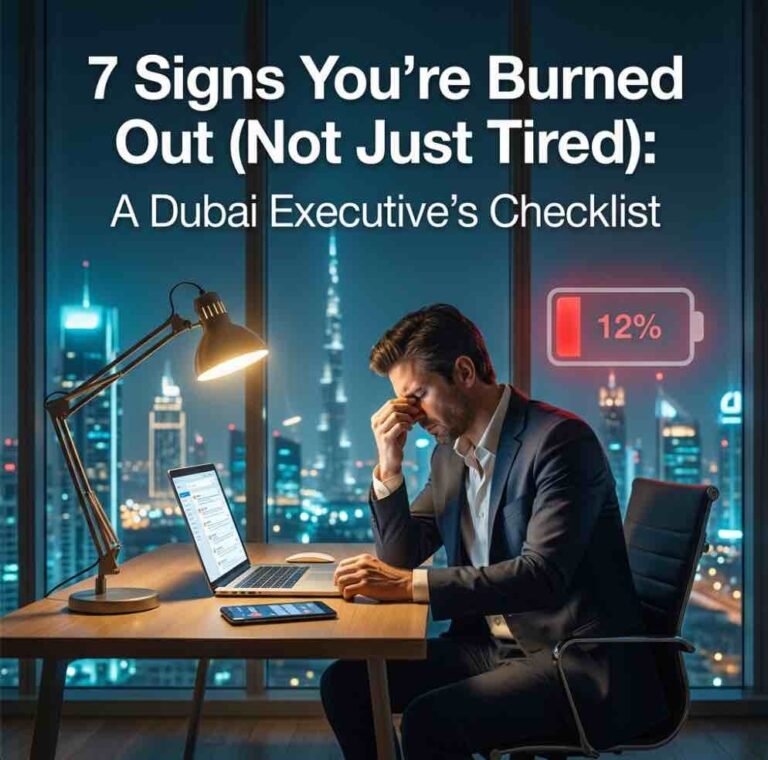
Tired resolves with rest. Burnout doesn’t. Tired is a battery that recharges over the weekend. Burnout is a battery that’s been running on empty so long it’s started to corrode. The phone still turns on. But it’s operating at 12% and the charging cable no longer works.
Here are seven signs that distinguish real burnout from ordinary tiredness. If three or more resonate, you’re not just tired. You’re in trouble.
The 7 Signs
| 1 | Rest doesn’t restore you anymore You took the long weekend in the Maldives. You slept ten hours a night. You did absolutely nothing for four days. And by Tuesday of your first week back, you felt exactly the same as before you left. Maybe worse, because now you’ve used your “reset button” and nothing happened. The test: Think back to your last holiday or break of three or more days. How long did the relief last after you returned? If the answer is less than a week, rest is no longer solving your problem. The depletion runs deeper than sleep can reach. |
| 2 | You’re performing well but feeling nothing This is the most deceptive sign because it’s invisible from the outside. You’re still delivering. Your boss is still satisfied. Your numbers are still strong. But internally, the wins that used to light you up now register as nothing. You close a deal and feel… blank. You get promoted and feel… obligated. The engine is running, but the driver checked out months ago. The test: When was the last time you felt genuinely proud of something you accomplished at work? Not relieved. Not validated. Proud. If you can’t remember, you’re not underperforming. You’re burned out while performing. |
| 3 | Your tolerance for people has collapsed You used to be patient. You used to enjoy mentoring your team, navigating client relationships, even the social side of work. Now, a junior’s mistake that would have been a coaching moment makes you want to snap. Your partner’s request for attention feels like another demand. Small talk at networking events feels physically painful. You’re not becoming a worse person. You’re running on empty, and when there’s nothing left, irritability is what fills the gap. The test: Have the people closest to you — your partner, your team, your friends — started walking on eggshells around you? Have you been told you’re “different lately” or “on edge”? Your emotional bandwidth has collapsed, and the people around you are feeling it before you are. |
| 4 | Sunday dread has become a permanent state It used to be Sunday evening. That familiar heaviness in the stomach as the week ahead loomed. Now it’s Sunday morning. Or Saturday night. Or it never fully lifts — it just oscillates between low-grade dread and acute anxiety, with brief pockets of distraction in between. The anticipatory anxiety has lost its borders and leaked into every day of the week. The test: Can you identify a single day in the past month where you didn’t feel some form of work-related anxiety or dread? If not, the anxiety has become chronic rather than situational. That’s a burnout signal, not a work ethic one. |
| 5 | You’ve quietly abandoned things you used to love The gym membership you’re still paying for but haven’t used in weeks. The books stacked on your nightstand. The hobby that used to be your release. The dinner plans you keep cancelling. They didn’t disappear because you made a decision to stop. They disappeared because you no longer have the energy to start. Burnout doesn’t take things away dramatically. It erodes them gradually, until one day you look around and realise you can’t remember what you used to enjoy. The test: Name three things you did for pure enjoyment six months ago. Now ask yourself when you last did any of them. If the gap is measured in months rather than days, burnout has quietly stolen your capacity for pleasure — a clinical marker called anhedonia. |
| 6 | Your body is sending signals you’re ignoring Persistent headaches. Jaw clenching. Chest tightness that your cardiologist says isn’t cardiac. Digestive issues. Insomnia or, its equally harmful cousin, sleeping nine hours and still waking exhausted. Frequent illness — every cold going around catches you. Your body is not designed to sustain chronic fight-or-flight indefinitely. When it can’t get you to stop through fatigue, it escalates to physical symptoms. The test: Have you developed any new physical symptoms in the past six months that your doctor hasn’t been able to fully explain? Stress-related physical symptoms are your body’s emergency broadcast system. Ignoring them doesn’t make them quieter — it makes them louder. |
| 7 | You’re using achievement as a painkiller This is the most dangerous sign for high performers — and the hardest to recognise because it looks like success. Instead of feeling the emptiness, you work harder. You take on more projects. You chase the next deal, the next promotion, the next milestone. Not because you want it, but because standing still means facing what you’ve been running from. Achievement has become your anaesthetic. And like any anaesthetic, you need more and more of it to numb the same amount of pain. The test: Ask yourself: if all external markers of success were removed tomorrow — the title, the salary, the recognition — who would you be? If that question creates panic rather than curiosity, your identity has fused with your performance. That’s not ambition. That’s a burnout pattern. |
———
How to Read Your Score
| 0–1 signs | Normal stress range. You’re tired, not burned out. Rest, recovery, and sensible work habits should restore you. Keep monitoring. |
| 2–3 signs | Early burnout. You’re on the trajectory. Intervention now is significantly easier and faster than intervention six months from now. This is the stage where most people tell themselves “I just need a holiday.” They’re wrong. |
| 4–5 signs | Active burnout. Your operating system is in decline. Performance may still look intact externally, but the internal infrastructure is degrading. Without intervention, this escalates to health consequences, relationship damage, or a professional crisis. |
| 6–7 signs | Critical burnout. You are in crisis territory whether it feels like it or not. Your body, mind, and relationships are all under sustained assault. This requires immediate, targeted intervention — not another productivity hack or wellness retreat. |
Why Getting This Right Matters
The danger of confusing burnout with tiredness is that the solutions are completely different.
Tiredness is a recovery problem. Sleep more. Take a break. Delegate. These interventions work because the system is fundamentally intact — it just needs a recharge.
Burnout is a systems problem. The operating system itself — the beliefs, patterns, and identity structures driving your behaviour — is what’s broken. You can’t recharge a system that’s coded for self-destruction. You have to reprogram it.
This is why holidays don’t fix burnout. Why meditation helps but doesn’t resolve it. Why you can sleep eight hours, eat clean, exercise daily, and still feel hollow. The inputs are good. The operating system is corrupt.
For a deeper exploration of why burnout hits differently in Dubai and what actually resolves it at the root level, see our full article: Executive Burnout in Dubai: Why Hustle Culture Is Breaking High Performers.
What to Do With This Information
If you scored 3 or above, here’s the honest sequence:
First: rule out medical causes. Some burnout symptoms overlap with thyroid disorders, sleep apnoea, vitamin deficiencies, and other conditions. See your GP. Get bloodwork done. If there’s a physical component, address it.
Second: assess whether you need therapy, coaching, or both. If your burnout has crossed into clinical depression, anxiety disorder, or substance dependence, start with a licensed therapist. If you’re functional but stuck in patterns you understand but can’t break — the kind where you know what you should do differently but your operating system keeps overriding the intention — that’s where identity-level coaching like the R.I.S.E.™ Method delivers results fastest.
Third: stop treating the symptom and start addressing the system. Another holiday won’t fix this. Another productivity app won’t fix this. The pattern generating your burnout lives in your subconscious — in the beliefs about worth, rest, and identity that were programmed long before you moved to Dubai. Until those change, the symptoms regenerate no matter how many coping strategies you stack on top.
———
Ready to Find Out What’s Really Going On?
The free 30-minute assessment is designed for exactly this moment. We’ll go beyond the symptoms and identify the specific operating system driving your burnout — the beliefs about worth, the identity fusion with performance, the nervous system patterns keeping you locked in. You’ll leave with a clear map of where you stand and what the right next step is.
➡ Book Your Free Assessment at coach-g.com
———
Frequently Asked Questions
Can you be burned out and still performing well at work?
Absolutely — and this is what makes executive burnout so dangerous. High performers are experts at maintaining output even as the internal system deteriorates. The performance masks the decay. By the time burnout shows up in your numbers, it’s been compounding internally for months. This is why recognising the signs early matters more than waiting for external evidence.
Is burnout different from depression?
They share some symptoms — emotional flatness, loss of interest, fatigue — but they’re not the same. Burnout is occupational: it’s triggered by chronic work stress and is specific to your professional context. Depression is a broader clinical condition that affects all areas of life regardless of circumstance. However, untreated burnout can develop into clinical depression. If you’re unsure, a licensed mental health professional can help clarify the distinction.
How long does it take to recover from burnout?
Without targeted intervention, research suggests burnout recovery takes anywhere from six months to two years. With the R.I.S.E.™ Method, most clients report significant shifts within 4–8 sessions because the work addresses the subconscious patterns generating the burnout, not just the symptoms. The difference between surface-level coping and identity-level reprogramming is the difference between managing burnout and resolving it.
Should I tell my employer I’m burned out?
This depends entirely on your workplace culture and your relationship with leadership. In some organisations, disclosure leads to support. In others, it leads to being perceived as a liability. What I recommend to clients is this: address the root cause first, ideally through coaching. When you’re operating from a place of strength rather than depletion, you can make strategic decisions about what to share and with whom — from clarity, not desperation.
What’s the difference between burnout coaching and executive wellness programmes?
Corporate wellness programmes typically address surface-level interventions: stress management workshops, meditation apps, flexible working policies. These are helpful at the margins. Burnout coaching through R.I.S.E.™ addresses the identity-level programming that makes you susceptible to burnout in the first place. It’s the difference between giving someone a life jacket and teaching them to swim.
———
About Coach G
Coach G is Dubai’s expert life coach for executives and high-achievers, with 15+ years of experience transforming lives across four continents. Creator of the R.I.S.E.™ Method (Reveal • Integrate • Shift • Embody), Coach G combines quantum psychology, Jungian depth work, neuroscience, and NLP to deliver identity-level transformation in weeks, not years. Executive MBA. 500+ lives transformed.
➡ Learn more: coach-g.com/about-coach-g
Share:
Categories
Popular Posts

How to Unfuck Your Life in 5 Minutes
September 5, 2026

The Secret Was Incomplete, here are the missing keys.
September 4, 2026

Michelangelo Never Named It “The Creation of Adam.” Salesmen Did.
September 4, 2026
Tags
Book Summary
Coach G
Coaching
consciousness
ego
Emotional Healing
Emotional Intelligence
Emotional Resilience
empowerment
faith
forgiveness
Growth Mindset
healing
Inner Peace
law of attraction
letting go
life coach
life coach Dubai
Life Coaching
Life Coaching Dubai
Manifestation
marriage
Mental Health
Mindfulness
Mindset Shift
oneness
Personal Development
personal growth
Personal Transformation
Positive Mindset
productivity
quantum psychology
relationships
Resilience
Self-Awareness
Self-Discovery
Self-Improvement
Spiritual Awakening
spiritual coach
spiritual growth
spirituality
Success Mindset
Time Management
Transformation
Universal Laws
© 2026 Coach G Dubai. All rights reserved.


