

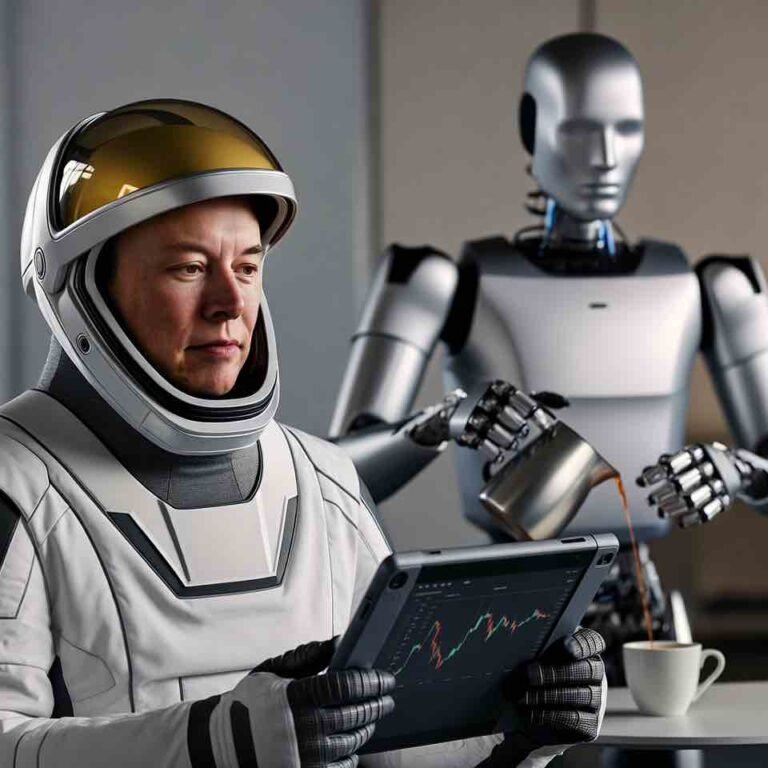
Elon’s Stark Warning
In a world accelerating toward artificial intelligence dominance, Elon Musk’s predictions often blend audacious optimism with sobering realism. Recently, Musk has reiterated his vision of a future where AI and robotics usher in “universal high income” (UHI), a state of abundance where work becomes optional and scarcity is eradicated. Unlike universal basic income, which provides a minimal safety net, UHI promises prosperity for all, access to the best medical care, food, homes, and transportation without the need for labor. But Musk isn’t naive about the transition. He foresees social unrest alongside this abundance, driven not by economic hardship but by profound psychological upheaval.
Musk’s statements, echoed in various interviews and posts, paint a picture of a post-labor society where AI outperforms humans in every task, rendering jobs obsolete. The fear stems from the speed of this shift: AI’s exponential progress won’t allow for gradual adaptation. People won’t just lose their paychecks; they’ll lose their sense of purpose. As one observer noted, drawing from Musk’s insights, this transition could be “the hardest thing humanity has ever tried to survive”, not due to material want, but because of the existential void left behind.
At the heart of this crisis is a fundamental truth: challenges are the core of what gives life meaning. In a world of effortless abundance, where cheap dopamine hits from endless entertainment replace the grind of achievement, humanity risks drifting into nihilism. This article explores this impending meaning crisis, emphasizing why challenges (not fleeting pleasures) are essential to human fulfillment. We’ll delve into the psychology of work, the science of flow, and strategies for navigating a post-scarcity era, all while confronting the brutal reality Musk warns about.
Understanding Universal High Income: Beyond Basic Needs
Universal High Income, as Musk describes it, isn’t about handouts; it’s the inevitable outcome of technological abundance. In this future, humanoid robots like Tesla’s Optimus will handle all manual and intellectual labor, from surgery to manufacturing, better than any human. Musk envisions a society where “everyone can have whatever goods and services they want,” with no scarcity except what we artificially impose. This goes beyond universal basic income, which Musk has critiqued in current contexts but sees evolving into UHI in an AI-driven world.
Economically, this makes sense. AI could boost global productivity to unprecedented levels, generating wealth that trickles down (or rather, floods) to everyone. But the psychological ramifications are profound. In a post-scarcity society, where basic needs are met without effort, the human drive for survival evaporates. Psychologists argue that scarcity has long shaped our motivations; its absence could lead to a reevaluation of values, potentially fostering boredom or purposelessness.
Musk’s optimism is tempered by realism. He acknowledges that while UHI solves poverty, it creates new problems:
“It is less clear how we will find meaning in a world where work is optional.”
This echoes broader concerns in post-scarcity discussions, where abundance might amplify inequalities in purpose rather than wealth. The transition won’t be smooth; rapid job displacement, already evident with AI layoffs, could spark unrest as people grapple with identity loss.
The Speed of Change: A Psychological Shockwave
The terror in Musk’s prediction lies in the velocity of transformation. AI isn’t evolving linearly; it’s exponential. Musk warns that
“The change will be so fast that people will be scared out of their minds.”
Jobs won’t fade gradually; they’ll vanish existentially as AI surpasses human capabilities overnight.
Psychologically, this abrupt shift disrupts our sense of stability. Work isn’t just income; it’s a structure for daily life, providing routines that foster mental health. Sudden unemployment can lead to depression, anxiety, and a loss of self-worth, amplified in a society where labor defines identity. Studies show that meaningful work correlates strongly with overall life satisfaction, acting as a buffer against existential dread.
In post-scarcity scenarios, this speed exacerbates the issue. Without time to adapt, societies might face widespread confusion and backlash. Historical parallels, like the Industrial Revolution, show how rapid technological change sparked social upheavals. But AI’s pace dwarfs that era, potentially leading to a “meaning crisis” where billions question their place in the world.
Work as the Pillar of Human Meaning
For centuries, work has been more than survival, it’s the primary source of meaning. From Aristotle’s eudaimonia to modern positive psychology, labor is seen as a path to self-actualization. Work builds skills, fosters community, and instills a sense of accomplishment. Removing it doesn’t yield enlightenment; it risks nihilism.
Research confirms this: Meaningful work drives life purpose, with factors like task significance and autonomy enhancing fulfillment. In UHI’s world, without these anchors, people might turn to hedonism, but studies suggest that’s insufficient. True meaning arises from contribution and growth, not passive consumption.
Musk’s vision challenges this paradigm. If robots provide everything, what remains? The answer lies in redefining work, not as necessity, but as voluntary pursuit of passion. Yet, for many, this shift could feel like a loss, leading to anger and societal friction.
Challenges: The Core of Life’s Texture
Herein lies the problem:
“Challenges are what give life meaning, not cheap dopamine”.
Psychologist Mihaly Csikszentmihalyi’s flow theory explains this beautifully. Flow occurs when skills match challenges, too easy leads to boredom, too hard to anxiety. In flow, we’re fully immersed, experiencing intrinsic joy from the effort itself.
Challenges trigger healthy dopamine release upon completion, reinforcing perseverance. This differs from “cheap dopamine”, instant gratification from scrolling or binge-watching, which hijacks reward systems without growth. Cheap dopamine leads to addiction and emptiness, as it decouples reward from effort.
In a post-labor world, without built-in challenges, life loses “texture,” as Peter Diamandis references Wall-E—a dystopia of sedentary, purposeless humans. Challenges force growth, building resilience and self-esteem. Removing them risks a flat existence, where abundance feels hollow.
Science backs this: Overcoming obstacles fosters eudaimonic well-being, a deeper happiness than hedonic pleasure. Post-scarcity psychology suggests we’ll need new challenges, artistic, exploratory, or communal, to thrive.
The Perils of Cheap Dopamine in Abundance
Cheap dopamine is the siren song of post-scarcity. In a world of infinite entertainment, AI-curated pleasures could trap us in loops of wanting without liking. Dopamine motivates pursuit, but over-reliance on quick hits, social media likes, virtual realities erodes long-term fulfillment.
This paradox explains why challenges matter: They provide sustainable motivation. Goal-setting releases dopamine, but pursuit and achievement build lasting habits. In UHI, without challenges, we might default to dopamine traps, leading to societal stagnation.
Wall-E illustrates this: Humans, freed from labor, devolve into obese consumers, their lives devoid of meaning. Real-world parallels exist in lottery winners or retirees who struggle without purpose. The antidote? Cultivating challenges that demand effort, ensuring dopamine serves growth, not escapism.
The Meaning Crisis: From Confusion to Backlash
The post-labor transition is humanity’s biggest meaning crisis. Removing work overnight breeds confusion: Who am I without my job? Anger follows, as perceived injustices mount. Nihilism creeps in, questioning life’s point in abundance.
Social unrest is inevitable, as Musk predicts. Displaced workers might rebel against AI overlords and revolt on a global scale. Psychological studies on scarcity show that its absence can amplify anti-reward states, leading to mental health declines.
Yet, this crisis can also be an opportunity. By embracing voluntary challenges, space exploration, creative endeavors, self-discovery, and enlightenment through the search for the true self, or those who won’t be sucked into the system by will, we can redefine meaning. Maslow’s hierarchy extends here: Beyond basics, self-transcendence awaits.
Lessons from Wall-E and Historical Parallels
Wall-E isn’t just fiction; it’s a cautionary tale. In Pixar’s vision, humanity’s challenge-free life leads to physical and spiritual atrophy. Diamandis invokes it to highlight how ease erodes vitality.
Historical shifts, like automation in agriculture, displaced workers but created new roles. AI differs in scope, potentially obsoleting all jobs. Lessons: Foster education in AI literacy and encourage “job crafting” for meaning in remaining work.
Preparing for the Brutal Transition
We’re underestimating the brutality, but preparation is possible. Policies like financial literacy, as Ray Dalio suggests, can ease the shift. Culturally, promote challenge-based pursuits: Sports, arts, volunteering.
Individually, seek flow activities now. Societies must design structures for purpose, perhaps AI-assisted quests or communal projects.
Embracing the Future with Eyes Wide Open
Musk’s UHI vision terrifies because it exposes our reliance on challenges for meaning. Yet, it’s a call to evolve, and it already seems too late to stop it. By prioritizing growth over cheap dopamine, we can transform this crisis into enlightenment. The transition will be hard, but humanity’s resilience, forged in challenges, will see us through. In abundance, meaning won’t be given; it’ll be created. That being for those who didn’t already lose themselves or their creation skills.


MEET COACH G.
I help individuals like you reprogram your mind, break free from subconscious limitations, and expand your awareness to create lasting transformation. Your consciousness shapes your reality—when you shift your perception, you unlock new levels of success, resilience, and fulfillment effortlessly. Blending Quantum Psychology, Ancient Wisdom, and cutting-edge neuroscience, I guide you through deep transformation—helping you dissolve mental barriers, rewire old patterns, and step into a life of clarity and limitless potential. Based in Dubai & available online, I’m here to help you harness the power of your mind and reshape your reality.