

January 5, 2026
Coach G
No Comments
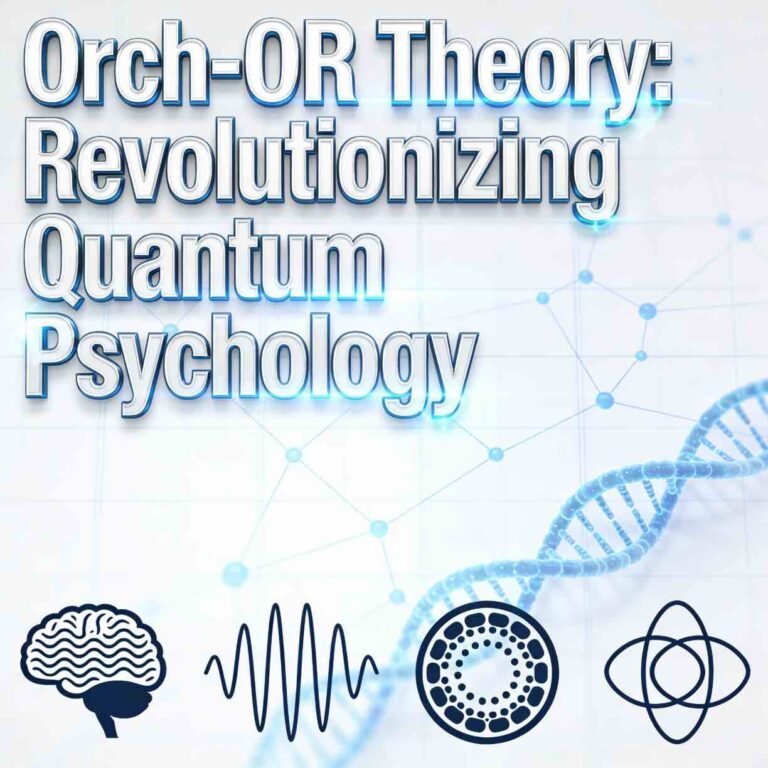
The Orchestrated Objective Reduction (Orch-OR) theory, developed by physicist Sir Roger Penrose and anesthesiologist Stuart Hameroff, proposes that consciousness emerges from quantum mechanical processes within the brain’s neuronal microtubules. Unlike classical neuroscience models that view the brain as a complex network of firing neurons operating like a digital computer, Orch-OR suggests that subjective experience, our inner world of thoughts, feelings, and awareness, arises from orchestrated quantum computations that collapse due to gravitational effects, creating discrete moments of consciousness. This theory bridges quantum physics and biology, offering a framework that not only addresses the “hard problem” of consciousness (why we have qualia, the subjective, first-person qualities of conscious experience, the “what it is like” aspect of mental states) but also has profound implications for quantum psychology and personal growth.
Quantum psychology explores how principles from quantum mechanics, such as superposition, entanglement, and wavefunction collapse, can explain psychological phenomena like decision-making, perception, and mental disorders. Self-development, on the other hand, encompasses practices aimed at enhancing emotional intelligence, resilience, creativity, and overall well-being. By integrating Orch-OR into these fields, we gain tools to understand and optimize the mind at a fundamental level. This article will study how Orch-OR advances quantum psychology, its practical applications for self-development, and the compelling reasons for adopting this model over purely classical alternatives.
How Orch-OR Contributes to Quantum Psychology
Quantum psychology posits that the mind isn’t strictly deterministic or classical but involves probabilistic, non-local processes akin to those in quantum mechanics. Traditional psychology relies on models like cognitive behavioral therapy (CBT) or psychoanalysis, which treat thoughts and behaviors as products of neural circuits and environmental conditioning. However, these often fall short in explaining phenomena such as intuition, creativity, or the sudden “aha” moments that seem to transcend linear reasoning.
Orch-OR provides a mechanistic explanation by locating consciousness in microtubules, hollow protein structures inside neurons that facilitate cellular transport and structure but, according to the theory, also host quantum computations.
In detail, microtubules are composed of tubulin dimers that can exist in quantum superposition states, allowing multiple potential configurations to coexist until an objective reduction (OR) event collapses the wavefunction. This collapse, orchestrated by biological processes (hence “Orch”), produces a conscious moment, potentially correlating with brain waves like gamma oscillations (30-90 Hz). In quantum psychology, this model explains how negative thought patterns, such as those in depression or anxiety, might arise from repeated collapses into low-energy states, essentially “entangling” the mind with victimhood or despair vibrations.
For instance, rumination in depression can be seen as a quantum loop where attention (the “observer”) chronically collapses possibilities into negative outcomes, entrenching neural pathways. Orch-OR suggests that interventions like mindfulness or hypnosis could access these superposed states, allowing rewiring by preventing premature collapse and fostering coherence with positive vibrations. This aligns with quantum semiotics, where signs and meanings in consciousness are influenced by quantum states, integrating Orch-OR to model how symbols in therapy (e.g., affirmations) interact with microtubule vibrations.
Furthermore, Orch-OR addresses the quantum-classical divide in psychology. Classical models struggle with free will, portraying decisions as predetermined by prior causes, but Orch-OR introduces non-computable elements from quantum gravity, enabling genuine choice and retroactive influence (where collapses affect past superpositions). This has implications for understanding psychological time, how we perceive past traumas or future anxieties, as unified with physical time through microtubule processes. In therapy, this could mean techniques that “re-collapse” memories, altering emotional entanglements and promoting healing.
Overall, Orch-OR elevates quantum psychology from speculative philosophy to a testable science, providing a biological substrate for quantum effects in cognition, emotion, and behavior.
Applications to Self-Development
Orch-OR’s insights extend beyond theory into practical self-development strategies, empowering individuals to harness quantum-like processes for personal growth. By viewing consciousness as “rippling vibrations in the structure of the universe,” the theory encourages practices that align one’s mind with self-similar patterns across scales, from cellular to cosmic. This fosters a holistic approach to self-improvement, where quantum psychology informs techniques for enhanced awareness and transformation.
One key application is in enhanced self-awareness. Orch-OR suggests that introspection involves observing quantum superpositions in microtubules, allowing access to multiple mental states simultaneously. Practices like meditation can prolong coherence, reducing decoherence from environmental noise and enabling deeper insight into subconscious patterns. For example, mindfulness training might prevent wavefunction collapse into habitual negativity, promoting a “superposed” state of equanimity that builds emotional resilience. In self-development programs, this translates to journaling or visualization exercises designed to “orchestrate” positive collapses, rewiring limiting beliefs at a quantum level.
Another area is improved mental health. Orch-OR links anesthesia’s erasure of consciousness to disruptions in microtubule quantum channels, suggesting that mental disorders involve similar decoherence. For self-development, this implies using biofeedback or neurofeedback to tune brain oscillations, restoring entanglement with “higher” states. Techniques like breathwork or yoga could enhance prana (life force) flow, mirroring microtubule vibrations and combating depression by fostering proto-conscious qualia of joy. Research-inspired apps might guide users through “quantum thinking” exercises, where parallel cognitions are explored to break depressive loops.
Orch-OR also boosts decision-making and creativity. The theory’s non-computable aspects explain intuitive leaps as quantum computations accessing Platonic truths beyond algorithms. In self-development, this encourages “flow states” where individuals align with universal patterns, enhancing problem-solving. Creative practices, such as art therapy, could stimulate microtubule resonances, leading to innovative breakthroughs. Moreover, understanding consciousness as a “creator’s” force (active rather than passive) empowers goal-setting, where intentions influence quantum outcomes.
Finally, Orch-OR supports spiritual self-development. By portraying mind as tuned to the universe, it bridges science and spirituality, encouraging practices like prayer or contemplation to entangle with cosmic coherence, reducing ego-driven isolation. This holistic view promotes long-term growth, turning self-development into a quantum journey of unification.
Why Use the Orch-OR Model
The Orch-OR model is adopted in quantum psychology and self-development for several compelling reasons.
First, it offers the most complete and falsifiable explanation for consciousness, addressing gaps in classical neuroscience like the binding problem (how disparate brain activities unify into experience) through quantum entanglement. Classical models treat the brain as a computer, but they can’t explain non-algorithmic reasoning, free will, or qualia, issues Orch-OR resolves via quantum gravity and microtubule computations.
Second, it provides a deeper understanding of brain mechanisms, opening doors to novel therapies. For psychology, it explains how quantum processes link to psychological time and measurement problems, where observation (attention) collapses mental states. This is crucial for treating disorders where classical approaches fail, like treatment-resistant depression.
Third, Orch-OR has evolutionary and practical motivations beyond the Penrose-Lucas argument (which critiques computationalism using Gödel’s theorems). It accounts for anesthesia effects, quantum biology in other systems (e.g., photosynthesis), and potential super-Turing capabilities that confer survival advantages. In self-development, this model’s testability, through predictions like microtubule resonances detectable in experiments, ensures it’s grounded in science, not pseudoscience.
Finally, Orch-OR challenges reductionist views, integrating physics , neuroscience, and philosophy for a unified theory that inspires innovative self-help tools. While controversial, its accumulating evidence (e.g., recent studies on superradiance in microtubules) makes it a forward-thinking choice for advancing human potential.
Final words…
Orch-OR theory transforms our grasp of the mind by embedding quantum processes in psychology and self-development, offering pathways to profound personal evolution. By understanding consciousness as orchestrated quantum events, we can cultivate awareness, heal mental wounds, and unlock creativity in ways classical models cannot. As research progresses, Orch-OR may redefine not just science, but how we grow as individuals in a quantum universe.

MEET COACH G.
I help individuals like you reprogram your mind, break free from subconscious limitations, and expand your awareness to create lasting transformation. Your consciousness shapes your reality—when you shift your perception, you unlock new levels of success, resilience, and fulfillment effortlessly. Blending Quantum Psychology, Ancient Wisdom, and cutting-edge neuroscience, I guide you through deep transformation—helping you dissolve mental barriers, rewire old patterns, and step into a life of clarity and limitless potential. Based in Dubai & available online, I’m here to help you harness the power of your mind and reshape your reality.
Share:
Categories
Popular Posts



Tags
Book Summary
Coach G
Coaching
consciousness
ego
Emotional Healing
Emotional Intelligence
Emotional Resilience
empowerment
faith
forgiveness
Growth Mindset
healing
Inner Peace
law of attraction
letting go
life coach
life coach Dubai
Life Coaching
Life Coaching Dubai
Manifestation
marriage
Mental Health
Mindfulness
Mindset Shift
oneness
Personal Development
personal growth
Personal Transformation
Positive Mindset
productivity
quantum psychology
relationships
Resilience
Self-Awareness
Self-Discovery
Self-Improvement
Spiritual Awakening
spiritual coach
spiritual growth
spirituality
Success Mindset
Time Management
Transformation
Universal Laws
© 2026 Coach G Dubai. All rights reserved.


