

September 4, 2026
Coach G
No Comments
And the label they sold you has been telling you what to see ever since.
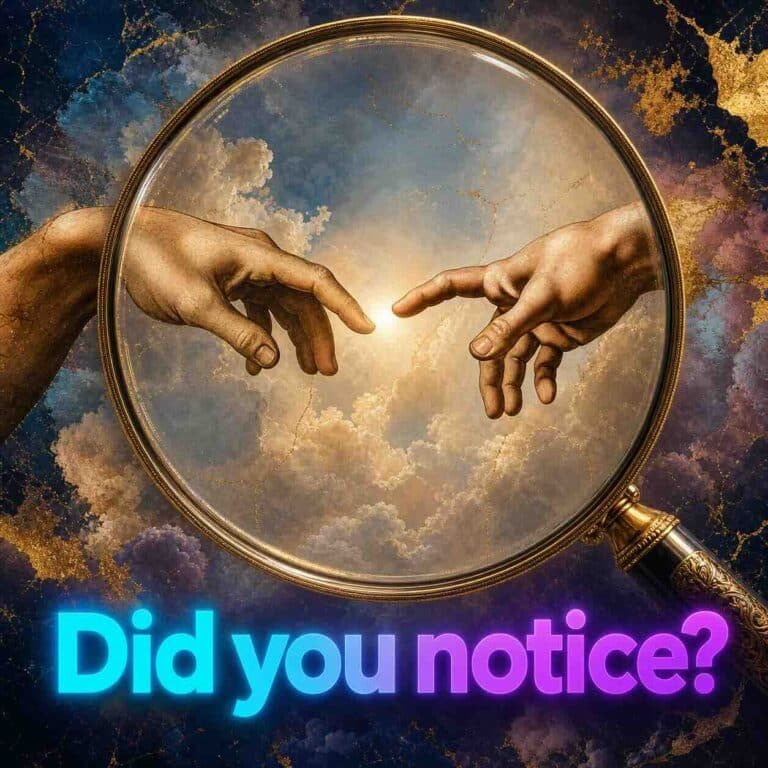
I have known this image my whole life and I had never once looked at it.
Until I did.
That is not a humble-brag opening. I mean it literally. I could have drawn those two hands from memory at eight years old. It has been on a fridge magnet, a phone case, a hundred parodies in my feed, the cover of a book I never finished. It is wallpaper. And wallpaper is the one thing your eye is trained to slide off.
It took someone asking me a question I could not answer. So I went and looked. Properly. For a long time.
I have not really recovered.
Let me start where I started, which is with the four words printed underneath it.
Michelangelo did not write them.
He did not name that panel at all, and not because he was being mysterious. In 1512 paintings simply did not have names. The whole concept had not been invented yet. A patron and an artist agreed on a subject, the work went into a specific building, and every single person who walked into that building already knew exactly what they were looking at. A fresco painted into a ceiling is probably the last object on earth that needs a label stuck under it.
Titles arrived much later. And they arrived, as most things do, because of money.
There is a scholar named Ruth Bernard Yeazell who wrote a whole book on this called Picture Titles, and her conclusion is unsentimental: naming a painting was never an act of creation. It was an act of reception. The names came from the middlemen. Dealers. Auctioneers. Catalogers. And most of all printmakers, because the moment you engrave a famous image and start selling copies of it across Europe, you need a line of text under the plate so the buyer knows what he is buying.
The printmaker wrote that line. Not the artist. Yeazell puts the 1790s as the decade when the modern picture title really settled into place.
So the plaster dried in 1512, and the naming machinery got moving somewhere around 280 years later.
Which means The Creation of Adam is not a title. It is a caption. Written by a salesman, three centuries after the fact, to shift product.
And the whole world inherited the verdict without ever sitting through the trial.
The two men who actually knew him both got it wrong
This is the part that made me sit down.
Giorgio Vasari published his account of the ceiling in 1550 and revised it in 1568. Ascanio Condivi published his in 1553, and he wrote it with Michelangelo more or less looking over his shoulder. These are our closest witnesses. One of them ate meals with the man.
They both misread a panel.
The scene we now call the Sacrifice of Noah sits out of order in the sequence, and Vasari and Condivi both looked up at it and confidently identified it as Cain and Abel bringing their offerings. Wrong story, wrong men, wrong chapter of Genesis, on the same ceiling they were writing a book about.
Sit with that for a second, because it changes what the captions are worth.
If the two people closest to Michelangelo could stand in that room, tilt their heads back, and name the wrong scene, then the words underneath these images are not authority. They are somebody’s reading. Sometimes a very good one. And sometimes an error that stands for four hundred years because it never occurred to anyone to check the caption against the wall.
We do not even know for certain who advised the theology up there. Some scholars make the case for Cardinal Vigerio. Others argue for Egidio da Viterbo. Condivi says Michelangelo just read the Old Testament himself, over and over, and worked from scripture instead of from what other painters had done.
So the honest summary is short. We know who painted it. We do not know who named it. We are not entirely sure what it means.
Which leaves one question, and I would like you to actually look at the painting before you answer it.
If this is the creation of Adam, why are his eyes already open?
Nothing is being made in this painting
Go and find the fresco. Not the mug. The fresco.
Adam is not clay. He is not a lump of something being pressed into a shape. He is finished. Grown, muscled, built like an athlete, chest already rising. His eyes are open and focused, and he is not drowsy or half-waking or blinking into the light.
He is looking directly at God before anything has touched him.
Whatever is coming across that gap, it is not a body. The body is already there and it is already beautiful.
And this was not Michelangelo going rogue. It is actually the older tradition. On the front of San Petronio in Bologna there is a relief by Jacopo della Quercia where the Creator stands on the ground and blesses an Adam whose body is already complete. Michelangelo studied that relief closely as a young man. Ghiberti did something similar in Florence.
They all understood something that our English Bibles quietly flatten. Genesis 2:7 does not describe one event. It describes two.
And the LORD God formed man of the dust of the ground, and breathed into his nostrils the breath of life; and man became a living soul.
Formed. Then breathed.
Two separate movements with a comma sitting between them.
Michelangelo painted the comma.
The Hebrew says it even harder. Adam comes from adamah, which means ground, soil, red earth. The name is literally the raw material. But neshamah, the breath, does not come from the ground at all. It comes from the mouth of God.
It is not manufactured on site. It is imported.
Body from the earth. Mind and spirit from somewhere else entirely.
That is what the salesman’s caption buried. This is not a man being built. This is a man receiving the one thing the dirt could never have given him.
Now look properly
Start with the ground. Adam’s skin is almost exactly the same color as the rock he is lying on. Ochre, brown, olive, the whole earth palette. He does not sit on top of the hillside so much as rise out of it, like a swell in the ground that happened to grow a face. Michelangelo painted the etymology and hoped you would feel it before you could explain it.
Then notice there is no garden. Look at that hillside. It is bare. Nothing growing, no trees, no rivers, no fruit, no serpent. And this is not because he could not be bothered, because two panels over he paints Eden in loving botanical detail for the Temptation. He removed it here deliberately. Take away the garden and you take away the once-upon-a-time. What is left is not a scene from a story. It is a diagram of a condition. Not what happened. What is always happening.
Then notice that God never stops moving. Walk the nine panels and watch Him. Separating light from dark, He is a torso caught mid-rotation with no stable axis anywhere in the figure. Creating sun and moon, He is moving so fast that Michelangelo has to paint Him twice inside the same frame, arriving and leaving, because one body could not carry that much speed. He is the only figure on the entire ceiling with nothing underneath Him, for the simple reason that He is not standing on anything.
And then you arrive at our panel and there is a body lying still on a rock.
Adam is the first stillness in the whole ceiling.
Then notice the mirror, and where it breaks. The two figures are reflections of each other. Same diagonal through the body, same extended arm, same coiled muscle. Michelangelo did not need to write made in the image of God underneath. He said it as geometry and let your eye do the theology for him. And then he broke that mirror in exactly one place. God’s index finger is a straight line, at the absolute limit of its reach. Adam’s droops.
One joint. That is the entire difference between them.
Then notice that Adam is not actually reaching. This is the bit almost everybody misses, including people who love this painting. His arm is not lifted toward God. It is propped. His forearm is resting along the top of his own raised knee. The gesture is being carried by his leg, not generated by his shoulder.
He is making the shape of reaching without paying the price of reaching.
I have sat across from a lot of people over the years and I recognized that posture immediately, because I have watched it and because I have held it myself. It is the person who agrees with every word you say and changes nothing. It is the decision you accepted three years ago and have somehow never once acted on. The manuscript. The gym. The conversation with your father. The apology. The email you have rewritten eleven times and never sent.
The gesture is there. The extension is not.
The Creator of the universe is straining like a man reaching for someone going over a cliff.
And the man cannot be bothered to straighten one finger.
The woman nobody looks at
Now find her.
She is inside the cloak, tucked under God’s left arm, pressed against His side with His arm around her shoulder. She is the most overlooked figure in the most looked-at painting on earth, and I promise that once you see her you will never manage to unsee her again.
Because she is not watching the miracle.
Every other figure in that mantle is caught up in what God is doing. She is looking past His shoulder, out across the gap, straight at Adam.
Follow the eyes and you get a triangle. Adam is looking at God. God is looking at Adam. She is looking at Adam.
Nobody is looking at her.
So who is she? Nobody agrees, and honestly the disagreement is the best part.
Eve, say most people. Which is quietly devastating, because in Genesis she does not exist yet. Not formed. Not named. Not given. And here she is already, inside the embrace of God, watching the man she will one day be handed to. Not yet made, and already held.
The Virgin, say others. There is an influential line of scholarship arguing the whole ceiling is built on the doctrine of the two Adams: Christ as the second Adam who repairs what the first one broke, Mary as the second Eve. On that reading she is not looking back at the beginning at all. She is looking forward at the repair.
Wisdom, says a smaller group, and this one is my favorite. The Sophia of Proverbs 8, who was there before the foundations of the earth, standing beside God like a master craftsman while He worked, and whose delight, the text says, was with the sons of men.
Which would make her the one who has been watching him since before there was any ground for him to lie on.
Three readings, five hundred years, no agreement. Even she does not have a name we can settle on, which should tell you something about how much of what you think you know about this painting is just a caption somebody wrote.
But whichever one you take, they all land in the same place.
Before I formed thee in the belly I knew thee. (Jeremiah 1:5)
He hath chosen us in him before the foundation of the world. (Ephesians 1:4)
She is the proof that existing in God’s mind comes before existing in the world.
Which means you were in that mantle too. Before your parents met. Before the ground you are made of had a name. Long before anyone got the chance to tell you who you were.
And while you are in there, look at God’s other hand.
His right arm is flung out toward Adam and it does not connect. His left hand is resting on a child, often read as the Christ child, and it is touching him.
Two hands in one frame. One reaches and fails. One is already holding.
The painting may contain its own answer, and hardly anyone notices, because we are all staring at the fingers.
Every contact is complete except one
Count them. God is touching the child. His arm encircles the woman. The angels are gripping Him, pressed hard into His body. Adam is touching the earth along his entire length.
The one point of contact the whole composition is built around, the one your eye goes to instantly and then refuses to leave, is the only one that does not happen.
He froze it apart. Forever. A sliver of bare plaster carrying more weight than the rest of the ceiling put together.
Why he might have painted it this way
Michelangelo was taken into the Medici household at about thirteen and ate at that table for years. And that table was the Florentine Platonic Academy.
Marsilio Ficino was there, the man who translated the whole of Plato and the Hermetic writings into Latin and effectively handed them back to Europe. So was Giovanni Pico della Mirandola, whose Oration on the Dignity of Man argued that every other creature was issued a fixed nature at its making, and that man alone was issued none. Man can sink into the brutish or rise into the divine. He is the only creature who is a question instead of an answer.
Rome condemned parts of it. Pico had to defend himself.
That is the water this boy grew up in. And in Ficino’s system the soul does not begin in the body at all. It descends into matter, forgets what it is, and spends a lifetime trying to remember.
So the reading I have just walked you through is not a modern idea pasted onto a Renaissance wall.
It may be the native language of the man holding the brush, painted into the ceiling of the Pope’s own chapel, in a room where every cardinal in Christendom would stand underneath it and see nothing but Genesis.
I am not going to blur this for you
There are two ways to finish this thought and they are not the same religion. I have watched the blur between them do real damage to people, so let me lay them out clean.
One. Man is made in the image of God. Made, not emanated. A creature carrying a likeness, not a chip off God’s substance. The gap between the hands is moral. It was caused by sin. It gets closed by grace, from God’s side, at a cost God pays.
Two. Man is divine in origin. A spark that fell into matter and forgot. The gap is metaphysical. It was caused by forgetting. It gets closed by remembering what you already are.
The first is Christian orthodoxy. The second runs from the Gnostics, through Ficino, and straight out into most of what gets sold as spirituality today, frequently by people charging for it.
They use the same vocabulary. They mean opposite things.
Do not let anyone blur that for you, and please do not blur it for yourself.
That said.
Michelangelo lived inside that exact tension and never once resolved it in public. He was a devout Catholic who wept over Savonarola’s sermons and spent his last decades carving Pietàs. He was also a boy raised at Ficino’s table, who put pagan Sibyls on the ceiling of a Christian chapel and never explained himself to anybody.
He held both. In one body. For eighty-eight years.
Maybe the ceiling is not a resolution. Maybe it is an honest man painting a tension he could not solve, and maybe that is precisely why it still will not leave us alone.
Three things you have been told that are wrong
The brain. In 1990 a physician called Frank Meshberger argued in JAMA that the outline of God’s cloak matches a cross-section of the human brain. Michelangelo did dissect corpses at Santo Spirito in Florence and knew anatomy better than most surgeons of his century, so it is not a mad idea. I spent about a week completely convinced. Then I read the objections, and they are good ones. Most art historians are not persuaded, and the honest problem is that a swirling oval will look like whatever you are hoping to find in it. So hold it loosely. Although if it ever were proved, the sermon is brutal, because then God is not handing Adam a heartbeat at all. He is handing him a mind.
The suffering. He did write the poem, to his friend Giovanni da Pistoia. Goiter, beard pointing at heaven, spine bent like a bow, paint dripping onto his face, and he signs off with a gag that he was never a painter in the first place. But it is a funny poem, not a tortured one, and he wrote it early in the job. Also, he did not paint lying on his back. He designed his own scaffold and worked standing with his head cranked backward. The lying-down version comes from a Charlton Heston film in 1965, which is a strange thing to discover about something you were sure you knew.
The colors. They cleaned it between 1980 and 1994, and centuries of candle soot and varnish came away. What was underneath stunned everybody. Acid pinks, lime greens, brilliant oranges.
Half of what the world knew about this painting was dirt.
I will leave that one alone. It does not need my help.
The half-inch
So God has crossed the sky. Arm at full extension, hair and mantle blown back by His own speed, angels straining underneath Him because He is the one doing the traveling. Nothing held back.
And the fingers do not touch.
Now look at whose finger still has slack in it.
Not God’s. God’s is a straight line. There is no more finger to give.
Adam could close that gap by straightening one knuckle. It is the smallest available movement in the entire painting, and it is the only movement in the painting that God will not make on his behalf.
That half-inch is your will. God will cross a universe. He will not cross your consent.
One correction here, because I used to say this wrong.
People love the line that every religion on earth is a ladder and that Michelangelo painted the opposite. It is a great line. It is also not true, and the ceiling itself gives it away.
The ceiling is a ladder. Nine panels running from a drunk, naked Noah collapsed by the door, back through the flood, through the fall, through Adam, and up into pure light above the altar. Walk that chapel toward the altar and you are walking the soul’s return in reverse.
So the ascent is real. Here is the smaller and truer version:
The first move is never yours.
The ladder exists. Nobody builds his own bottom rung. The reach that starts the whole thing comes from the other direction, and by the time you feel any pull to close the gap, the crossing has already happened. You are not initiating contact.
You are answering a hand that has been held out at full stretch for a very long time.
The ceiling only shows you the before
Because the thing it is waiting for happened fifteen centuries after the scene it paints.
The touch happens.
Not above the clouds. In a feeding trough in Bethlehem, when the hand that flung the stars became a hand small enough to close around Mary’s finger.
God stopped reaching across the gap and stepped into it. He took a body. He took the dust. He took a hand.
And when that hand was finally stretched out as far as human arms go, extended exactly like the arm on that ceiling, full reach, nothing held back,
we nailed it there.
That is where the two fingers meet. At the cross. God at full stretch and man at his absolute worst, touching at last through an iron spike.
Three days later that hand was moving again. Folding grave clothes. Cooking fish on a beach for the men who had run. Holding out its scars to the one who said he would not believe without them.
It is still out there.
The ceiling is still true. He has done all the reaching. He has crossed all the sky. He has closed every inch that love can close without your permission.
The last half-inch has always been yours.
So let me ask you the real question
Michelangelo hid Plato in the Pope’s ceiling and nobody stopped him. He painted a man refusing to move, directly above the most powerful men in the Western world, and for five centuries every one of them has stood underneath it and seen a nice picture about creation.
The two men closest to him looked at that ceiling and named the wrong scene.
Then a print seller put four words under an engraving, and those four words told the next three hundred years of us what we were looking at.
And nobody checked.
I keep coming back to that.
What were you told about yourself that you accepted before you ever looked?
Who named your painting? A parent, a teacher, an ex, an industry, a diagnosis, one bad decade. And were they even in the room when it was made, or did they turn up centuries late with a caption and something to sell?
What are you calling your life that it was never actually called?
And where exactly is your arm resting on your knee right now, making the shape of reaching, while the finger stays curled?
You are not being asked to climb.
You are being asked to straighten one joint.
Lift your hand.

MEET COACH G.
I help individuals like you reprogram your mind, break free from subconscious limitations, and expand your awareness to create lasting transformation. Your consciousness shapes your reality—when you shift your perception, you unlock new levels of success, resilience, and fulfillment effortlessly. Blending Quantum Psychology, Ancient Wisdom, and cutting-edge neuroscience, I guide you through deep transformation—helping you dissolve mental barriers, rewire old patterns, and step into a life of clarity and limitless potential. Based in Dubai & available online, I’m here to help you harness the power of your mind and reshape your reality.
Share:
Categories
Popular Posts

How to Unfuck Your Life in 5 Minutes
September 5, 2026

The Secret Was Incomplete, here are the missing keys.
September 4, 2026

Michelangelo Never Named It “The Creation of Adam.” Salesmen Did.
September 4, 2026
Tags
Book Summary
Coach G
Coaching
consciousness
ego
Emotional Healing
Emotional Intelligence
Emotional Resilience
empowerment
faith
forgiveness
Growth Mindset
healing
Inner Peace
law of attraction
letting go
life coach
life coach Dubai
Life Coaching
Life Coaching Dubai
Manifestation
marriage
Mental Health
Mindfulness
Mindset Shift
oneness
Personal Development
personal growth
Personal Transformation
Positive Mindset
productivity
quantum psychology
relationships
Resilience
Self-Awareness
Self-Discovery
Self-Improvement
Spiritual Awakening
spiritual coach
spiritual growth
spirituality
Success Mindset
Time Management
Transformation
Universal Laws
© 2026 Coach G Dubai. All rights reserved.


