

August 20, 2026
Coach G
No Comments
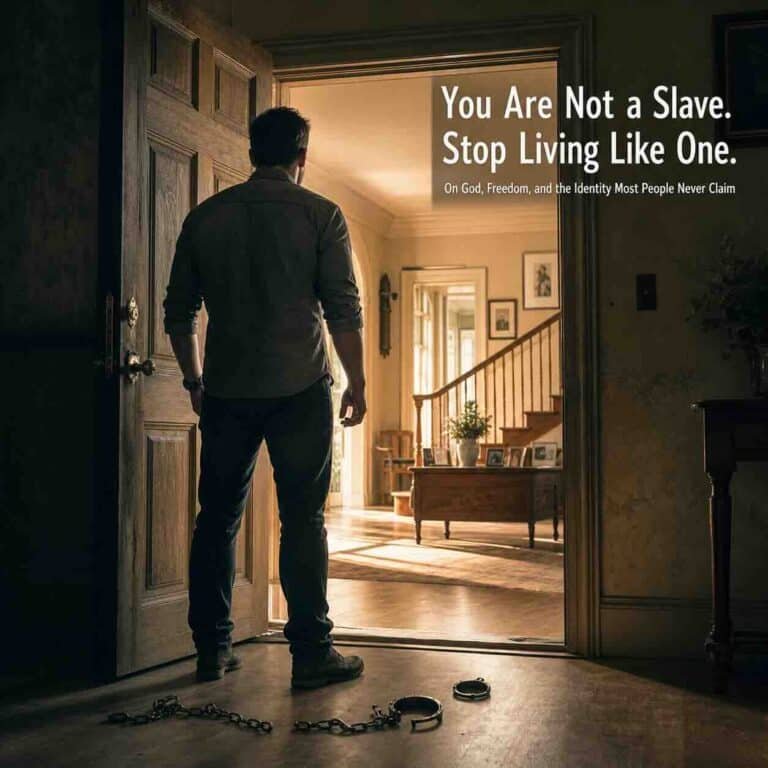
On God, Freedom, and the Identity Most People Never Claim
There is a question that has been sitting with me for years, and it is not a comfortable one.
If God is Father, why do most people who believe in God relate to him like frightened employees?
They pray like they are filing a request form. They obey like they are avoiding punishment. They worship like they are performing a duty to an authority they did not choose and cannot afford to disappoint. They carry their faith the way a servant carries a tray: carefully, dutifully, always aware of where the master is standing.
And the astonishing thing, the thing I cannot stop thinking about, is that this is not what was offered. This is not the deal. This is not, by any reading of any sacred text I have ever encountered, what God actually wants from the people he made.
What was offered was something almost shockingly different. What was offered was sonship.
Not service. Not submission. Not the performance of loyalty in exchange for protection. Sonship. The full inheritance. The same name. The same table. The same house.
And yet here we are, generation after generation, century after century, sitting at the door of that house, waiting to be let in, not realising the door was never locked.
It Goes Back Further Than You Think
To understand why we relate to God as slaves, you have to go back. Not just to childhood, not just to religious tradition, but to something that lives in the oldest layers of human organisation, something so ancient and so embedded that it may genuinely be written into how our nervous systems are wired.
For most of recorded human history, the overwhelming social reality was hierarchy. Not gentle hierarchy, not enlightened hierarchy, but the absolute, violent, total hierarchy of masters and slaves. The image of God in the Old and New Testaments is characterized by metaphors that attempt to put the divine into words implying a strong asymmetrical dependency: father versus children, shepherd versus flock, king versus people, creator versus creation, master versus slave.
This is not an accident. These were the only metaphors available. A people who had known slavery in Egypt, who lived inside empires built on subjugation, who understood power exclusively through the lens of domination and submission, could not have accessed the concept of divine relationship in any other vocabulary. The language was all they had.
But here is the error that compounded across millennia: we kept the vocabulary long after the relationship it was trying to describe had been offered to us in a completely different form. We kept calling ourselves servants when we had been told we were heirs. We kept bowing our heads to a king when we had been invited to the table as children.
And generation after generation, we passed this down. Not just in religion. In everything. In how we relate to authority, to society, to the systems and structures that govern our lives. We learned to trade freedom for comfort. Security for sovereignty. Identity for belonging.
We became, collectively, very good at being slaves.
The Architecture of the Slave Mind
I want to be specific about what I mean, because this is not abstract.
The slave mind operates from fear. It asks: what is the rule, and what is the punishment for breaking it? It does not ask: what is true, and what is right? It asks: what will keep me safe?
The slave mind trades freedom for predictability. It will accept a smaller life, a quieter life, a life that stays well within approved boundaries, in exchange for the guarantee that nothing too surprising will happen. Comfort becomes the highest value. Not growth. Not truth. Not love. Comfort.
The slave mind measures its worth by external approval. It has no internal compass. It does not know what it wants because it was never allowed to want. It knows what is permitted. It knows what is rewarded. It has become very skilled at giving people what they want in exchange for not being cast out.
And the slave mind, most devastatingly of all, has learned to call its chains by other names. It calls obedience to fear “faithfulness.” It calls the surrender of identity “humility.” It calls the avoidance of risk “wisdom.” It has built an entire moral vocabulary around the experience of smallness, and it uses that vocabulary to keep itself, and everyone around it, small.
This is not God’s design. This is conditioning. This is what happens when generations of human beings live under systems of control so total and so long-lasting that they forget the difference between the cage and the sky.
Freedom does not culminate in personal liberty, but rather in a deeper dependency on God. The paradox here is crucial. The ancient Hebrew understanding was not that God frees you into independence. It is that God frees you from one dependency, the dependency on human systems of power, into another dependency, the dependency on something that actually loves you and actually knows what you are for. The question is not whether you will depend on something. The question is what you will depend on. Fear, or love. Caesar, or Father.
Most people, without realising it, choose Caesar. Every single day.
What Sonship Actually Means
Scripture draws a bold contrast between being slaves and being sons. Whereas the law imprisoned us in guilt, grace invites us into freedom. As Paul expresses in Galatians 4:7: “So you are no longer a slave, but a son, and if a son, then an heir through God.”
Read that carefully. Not a better servant. Not a trusted employee. Not a loyal subject with improved working conditions. An heir. Someone who gets everything. Someone for whom the entire estate is already, by right of relationship, theirs.
In Roman times when a son was adopted, his past history was completely erased and he was in all legal respects equal with those born into his new family. He had the same name, the same inheritance, the same position and the same rights as the natural-born sons.
This is the legal reality that Paul’s audience would have understood immediately, that we, living in a very different world, have largely lost. Adoption in the Roman world was not a charity arrangement. It was a complete transfer of identity. The adopted son stopped being who he was and became, entirely and irrevocably, a member of the new family. The old debts were cancelled. The old name was erased. The new name, the new inheritance, the new standing, were real and permanent and could not be taken back.
This is what is being offered. Not a parole arrangement. Not probationary membership. Not conditional acceptance dependent on continued good behavior. A complete, irrevocable, permanent transfer of identity from slave to son.
And yet.
Many believers are content with being justified servants rather than revelling in their full heirship.
Why? Why would anyone choose the servant’s quarters when the whole house is available?
Because the Servant’s Quarters Are Familiar
Here is the answer, and it is not flattering.
We choose smallness because smallness is familiar. We choose service because service has a clear structure. You know what is expected. You know how to succeed. You know what will happen if you fail. There are no frightening open horizons. There is a role, and you fill it, and however uncomfortable that role might be, it is at least known.
Sonship is terrifying precisely because it has no script. A son does not follow instructions; he inherits a vision. A son does not perform duties; he embodies a nature. A daughter does not wait to be told what to do; she acts from who she is, from the identity she carries, from the love she has been given and has chosen to give back.
This requires something that most people have spent their entire lives systematically avoiding: the willingness to know who you actually are, and to live from that, without the protection of a role, without the safety of a system, without the comfort of rules to hide behind.
If we embrace the reality of servanthood without the revelation of sonship, we take on a slave mentality. If we embrace the reality of sonship without the revelation of servanthood, we take on a spoiled mentality. We are sons and daughters who delight in voluntarily serving the One who called us to Himself.
This is the precise and difficult balance. The son serves, not because he must, but because he wants to. Not out of fear of consequence, but out of overflow of love. Not to earn a place at the table, but because he is already at the table and has understood what it cost to put him there.
That shift, from obligation to love, from fear to freedom, from slave to son, is the entire journey of the spiritual life. Everything else is commentary.
The Society That Replaces God
Now I want to make a turn that might surprise you. Because this conversation is not only about religion. It is about what happens when a culture loses its relationship with the divine and tries to find in human systems what only God was designed to give.
We are living in that moment.
The secular world did not free people from the slave mentality. It transferred it. People who no longer bow to God now bow to something else: to approval, to algorithms, to the market, to political tribes, to the opinion of strangers on the internet, to whatever metric their particular culture has decided measures human worth.
The gods have changed. The slavery has not.
And here is the devastating irony. The freedoms that modern secular society celebrates, freedom of expression, freedom of choice, freedom from traditional authority, are increasingly purchased at a hidden cost that nobody fully discloses at the point of sale. You are free to say what you want, as long as you say what is approved. You are free to choose, as long as your choices remain within the range of the commercially viable. You are free from the authority of God, as long as you submit to the authority of the market, the state, the algorithm, the crowd.
The chains are more comfortable now. They are made of convenience rather than iron. But they are chains.
You have not received a spirit that a slave has, you have received a spirit that a son has.
The question is whether you believe that. Not as a theological proposition. As a lived reality. As something that actually changes how you walk into a room, how you make decisions, how you respond when the world tells you to make yourself smaller, quieter, more manageable, more compliant.
Because here is what I have discovered, in my own life and in the lives of people I have walked alongside as a coach: the moment you genuinely understand and accept that you are a son, a daughter, an heir, not a servant earning your place but a child already within it, something shifts that cannot be unshifted.
You stop asking for permission. Not because you have become arrogant or untethered. But because you understand that the authority you carry does not come from human approval. It comes from something that no human system can grant or revoke.
You stop being afraid of losing your place. Because your place is not contingent on your performance. It was given. It is held. It will not be taken.
You stop needing comfort as a substitute for freedom. Because the love you are living inside is larger than any comfort, more stable than any security system, more nourishing than any convenience the world can offer in exchange for your sovereignty.
The Prodigal Son Reread
The parable of the Prodigal Son is the most radical story ever told about this dynamic, and almost nobody reads it correctly.
The younger son leaves. He wastes everything. He ends up feeding pigs, which for his Jewish audience was the most complete humiliation imaginable. And then, in the bottom of that humiliation, something stirs. The text says he “came to himself.” Not to his senses, which is how most translations flatten it. To himself. He remembered who he was. He remembered whose he was.
And notice what he decides to do on the walk home. He rehearses a speech. A servant’s speech. He is going to offer himself back as a hired hand. He has been so long inside the slave mentality that even in the moment of return, the best he can imagine is a role. A useful position. Something he can earn.
He never gets to deliver the speech.
The father sees him from a long way off and runs. The father does not wait with crossed arms for an explanation. He does not receive the rehearsed humiliation. He does not negotiate terms. He throws a party. He calls for the best robe, the ring, the sandals, the fatted calf.
The robe: restoring dignity. The ring: restoring authority. The sandals: slaves went barefoot; sons wore sandals. Every single gesture is a direct, deliberate reversal of slave status. The father is not reinstating his son on probation. He is saying: you never stopped being my son. The category never changed. Only your experience of it did.
And then the other son, the older one, who stayed home and worked faithfully all those years, and who is furious, reveals the secret that has been hiding in plain sight the whole time. He says: I have been here all along serving you, and you never threw a party for me.
The father’s answer is heartbreaking: Son, you are always with me, and everything I have is yours.
It was always there. The whole inheritance. The whole house. The whole love. He had been standing in it, working in it, living inside it, and relating to it as if he were a servant. He had been a son who chose, for reasons of safety and familiarity and perhaps pride, to live like a hired hand.
This is us. This is most of us, most of the time.
What It Takes to Live as a Son
I will not pretend this is easy. It is the hardest work there is. Because it does not require you to do more. It requires you to become more. It requires you to stop outsourcing your identity to systems that were never designed to hold it.
It requires you to sit with the terrifying and liberating truth that you are already loved, completely, not because of what you have produced or how well you have performed or how careful you have been to stay within approved boundaries. But because of what you are. Because of whose you are. Because the relationship was established before you did anything to earn it or ruin it.
This is not a license for carelessness. A son who understands his inheritance does not squander it. He is actually far more responsible than the servant, because his motivation is not fear of punishment but love for what he has been given. He protects what is his, not because the master is watching, but because he understands its worth.
But he does all of this from a completely different internal posture. From security, not anxiety. From abundance, not scarcity. From love, not fear.
And in a world that is increasingly organized around anxiety, scarcity and fear, this posture is not just spiritually significant. It is revolutionary.
Freer in God Than Anywhere Else
I want to close with something that cuts against everything modern secular thinking assumes.
The most free people I have ever encountered are not the ones who have successfully removed God from the equation. They are the ones who have most completely understood what God actually offers. They are the ones who have made the shift from slave to son so fully that they are genuinely untouchable by the things that terrorize everyone else. Social approval does not hold them captive. The market’s judgment of their worth does not move them. The threat of being cast out, cancelled, disapproved of, left behind, these things have lost their grip. Not because they are reckless. Because they are rooted in something that no human system can offer or remove.
There is a freedom available in genuine relationship with God that society cannot replicate and cannot compete with. Society can offer comfort. It can offer safety. It can offer belonging within approved parameters. What it cannot offer is the unconditional, irrevocable, inheritance-grade love of a Father who ran toward you before you finished the speech you were going to use to earn your way back in.
That love is the only thing strong enough to make a human being genuinely free.
Not free from responsibility. Free from the terror of being insufficient.
Not free from service. Free from the humiliation of service performed out of fear.
Not free from God. Free, finally, in God.
Stop waiting at the door.
You are not a servant. You never were.
Go inside.

MEET COACH G.
I help individuals like you reprogram your mind, break free from subconscious limitations, and expand your awareness to create lasting transformation. Your consciousness shapes your reality—when you shift your perception, you unlock new levels of success, resilience, and fulfillment effortlessly. Blending Quantum Psychology, Ancient Wisdom, and cutting-edge neuroscience, I guide you through deep transformation—helping you dissolve mental barriers, rewire old patterns, and step into a life of clarity and limitless potential. Based in Dubai & available online, I’m here to help you harness the power of your mind and reshape your reality.
Edit widget and choose a menu
Share:
Categories
Popular Posts

How to Unfuck Your Life in 5 Minutes
September 5, 2026

The Secret Was Incomplete, here are the missing keys.
September 4, 2026

Michelangelo Never Named It “The Creation of Adam.” Salesmen Did.
September 4, 2026
Tags
Book Summary
Coach G
Coaching
consciousness
ego
Emotional Healing
Emotional Intelligence
Emotional Resilience
empowerment
faith
forgiveness
Growth Mindset
healing
Inner Peace
law of attraction
letting go
life coach
life coach Dubai
Life Coaching
Life Coaching Dubai
Manifestation
marriage
Mental Health
Mindfulness
Mindset Shift
oneness
Personal Development
personal growth
Personal Transformation
Positive Mindset
productivity
quantum psychology
relationships
Resilience
Self-Awareness
Self-Discovery
Self-Improvement
Spiritual Awakening
spiritual coach
spiritual growth
spirituality
Success Mindset
Time Management
Transformation
Universal Laws
© 2026 Coach G Dubai. All rights reserved.


