

February 22, 2026
Coach G
No Comments
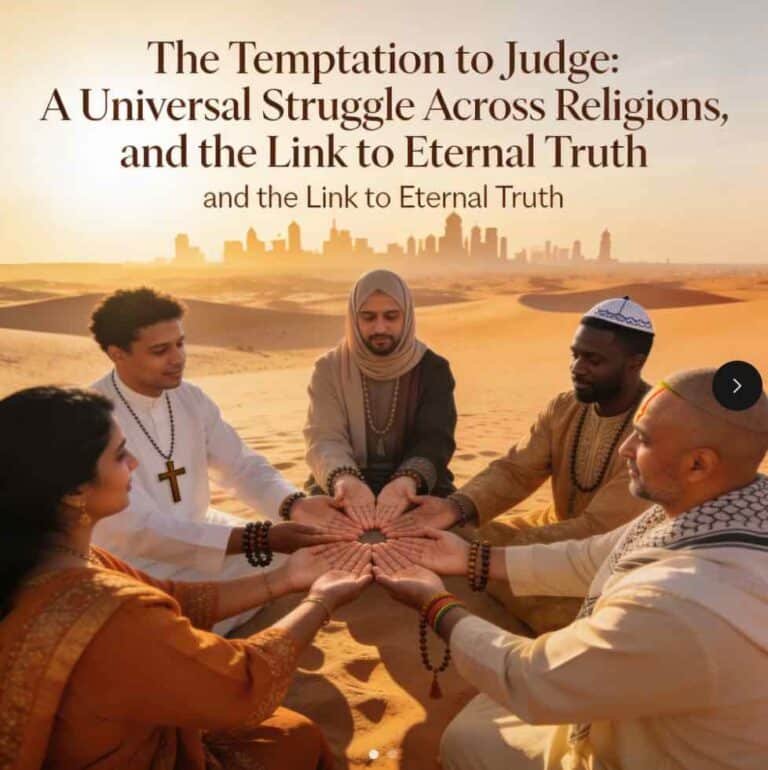
In a world completely buzzing with opinions, social media rants, and instant hot takes, judgment seems like second nature. We’ve all been there: scrolling through our feeds, shaking our heads at someone’s choices, or whispering (or shouting) about a colleague’s misstep. As followers of Christ, we’re reminded in Matthew 7:1, “Do not judge, or you too will be judged.” But this isn’t just a Christian dilemma; similar warnings echo across Islam, Judaism, Buddhism, Hinduism, and beyond. So why does this temptation persist universally, defying sacred teachings? And how does it point us toward a deeper, unifying Truth?
As Coach G., I’ve seen this play out in diverse lives, from athletes pushing their limits to executives navigating global teams. Judgment isn’t merely a personal flaw; it’s a barrier to harmony and growth. By exploring its roots and religious parallels, we can uncover a shared path to compassion, revealing a “link to Truth” that transcends faiths.
The Psychological Pull: Building Walls to Protect Our Ego
At its core, judgment often stems from our own insecurities. When we point out flaws in others, it’s like shining a spotlight away from our own vulnerabilities. Psychologists call this “projection,” a defense mechanism where we attribute our unresolved issues to someone else. For instance, if you’re struggling with procrastination, you might harshly judge a friend for being “lazy,” all while ignoring your own piled-up tasks.
This ties into cognitive biases like the fundamental attribution error: We blame others’ actions on their character (“They’re irresponsible”) but excuse our own with context (“I had a tough day”). It’s a quick ego boost, releasing feel-good chemicals in the brain that make us feel superior and in control.
Religious teachings universally challenge this. In Christianity, Christ urges self-examination first (Matthew 7:3-5). In Islam, the Quran warns in Surah Al-Hujurat 49:11, “O you who have believed, let not a people ridicule [another] people; perhaps they may be better than them.” Yet, introspection remains tough; judgment offers instant relief from our inner chaos.
Evolutionary Instincts: Survival of the Judgiest?
Believe it or not, judgment might be wired into our DNA. Back in our hunter-gatherer days, quickly sizing up others was a survival skill. Is this person trustworthy? A threat? A potential ally? Those snap judgments helped form tribes and avoid dangers. Fast-forward to today, and our brains still light up with dopamine during gossip or moral outrage; it’s biologically rewarding.
Neuroscience backs this: The same reward centers activated by food or social bonding fire up when we engage in judgmental chatter. In a competitive world, this instinct manifests as status-seeking; judging others elevates our perceived rank in the social hierarchy.
Across religions, this primal urge is countered with calls to humility. Buddhism teaches through the concept of “right speech” in the Noble Eightfold Path, avoiding divisive or harmful words that stem from judgment. Hinduism’s Bhagavad Gita (16:1-3) emphasizes ahimsa (non-violence), including in thought, urging detachment from ego-driven critiques. Judaism echoes this in Leviticus 19:15-18, commanding impartiality and love for neighbors, not hasty judgments. The temptation lingers because evolution favors quick tribal bonds, but sacred paths invite us to evolve spiritually beyond them.
Social and Cultural Forces: The Echo Chambers We Build
Society doesn’t just tolerate judgment; it often amplifies it. Think about the media landscape: news cycles fueled by scandal, reality TV built on drama, and social platforms like X, where outrage goes viral. Algorithms reward divisive content, training us to judge faster for likes, shares, and that sweet sense of belonging to “our side.”
Cultural norms play a role too. In some communities, including religious ones, judgment masquerades as “upholding standards.” We see it in cancel culture or partisan divides, where labeling someone as “wrong” reinforces group identity. It’s no wonder judgment feels normalized; it’s performative, earning social currency.
This contrasts with global religious wisdom. In Islam, Prophet Muhammad (peace be upon him) said, “A Muslim is the one who avoids harming Muslims with his tongue and hands” (Sahih Bukhari). Sikhism’s Guru Granth Sahib promotes equality, warning against caste-based judgments. Indigenous spiritualities often emphasize interconnectedness, treating judgment of others as harm to the communal web. In our hyper-connected era, these teachings feel countercultural, but they remind us that true community builds bridges, not walls.
The Spiritual Irony: When Faith Becomes a Weapon
Even within religions, the temptation to judge can twist devotion. Some misuse sacred texts to condemn others, prioritizing rules over hearts. In Christianity, this mirrors the Pharisees’ hypocrisy (Matthew 23:23-24). In Islam, it’s cautioned against in Surah An-Nisa 4:94, “O you who have believed, when you go forth in the cause of Allah, investigate; and do not say to one who gives you [a greeting of] peace, ‘You are not a believer.'” Buddhism warns of “wrong view” leading to judgmental attachments, while Hinduism speaks of maya (illusion) fueling egoic divisions.
Theologically, this reflects a shared human “fall”: pride over humility, as seen in concepts like original sin in Christianity, fitrah corrupted in Islam, or dukkha (suffering) from attachment in Buddhism. Overcoming it requires spiritual practices: prayer in Abrahamic faiths, meditation in Eastern traditions, or seva (service) in Sikhism.
In my coaching, I’ve integrated these insights. Clients from varied backgrounds who practice “judgment detox,” replacing criticism with curiosity, find deeper connections. It’s about responding with grace, as all religions ultimately advocate.
The Link to Truth: A Universal Call to Divine Unity
Why expand to other religions? Because the temptation to judge reveals a profound link to Truth: We’re all part of a greater whole, connected to the Divine. Judgment fragments this unity, born from fear and separation. But teachings across faiths point to oneness: Christian agape love, Islamic tawhid (God’s unity), Buddhist interdependence, Hindu Brahman (ultimate reality), Jewish tikkun olam (repairing the world).
This “link to Truth” is the realization that non-judgment isn’t weakness; it’s alignment with the sacred. By resisting judgment, we glimpse eternity: A world where empathy reigns, reflecting the compassion of the Creator (or Ultimate Reality). As Coach G., I’ve seen lives transformed when people embrace this; barriers dissolve, and potential unlocks.
Religions aren’t rivals; they’re facets of the same gem, guiding us home. If judgment tempts you, remember: The Divine judges with mercy, inviting us to do the same.
Concluding with the Truth of Oneness: Judging Only Ourselves, and Through That, the Creator
To bring this full circle, let’s anchor in the profound Truth of Oneness, the eternal reality that all existence is interconnected, a single divine expression. In this view, drawn from mystical traditions across religions (like Sufism in Islam, Kabbalah in Judaism, Advaita Vedanta in Hinduism, and Christian mysticism), there is no true “other.” We are all manifestations of the One: God, Brahman, the Ultimate Source.
Here’s the radical shift: The only one we truly judge is ourselves. When we criticize others, we’re projecting our inner shadows onto the mirror of the world. But in turning judgment inward, with compassion, not self-loathing, we engage in honest self-accountability. This self-judgment, done in humility, becomes a sacred act: Since we are sparks of the Divine, examining our flaws is, in essence, judging the Creator Himself within us. Not in arrogance, but in awe, recognizing that our imperfections are part of the divine play, opportunities for growth and return to wholeness.
Christ’s call to remove the plank from our own eye aligns here, as does the Islamic emphasis on self-purification (tazkiyah) and Buddhist self-inquiry into the illusion of self. By judging only ourselves, we dissolve the ego’s barriers, merging back into Oneness. This isn’t masochism; it’s liberation, freeing us from the cycle of division to embody divine love.
In coaching terms, this is the ultimate game-changer: Self-judgment with grace leads to self-mastery, revealing the Creator’s perfection in our humanity. Embrace it, and watch your world unify.
Breaking Free: A Path to Non-Judgmental Living Across Faiths
So, how do we resist this universal temptation? Start small, drawing from global wisdom:
- Self-Reflect Daily: Use Christian self-examination, Islamic muhasabah (self-accounting), or Buddhist mindfulness to trace judgments to their roots.
- Cultivate Empathy: Ask, “What’s their story?” Inspired by Hindu karma understanding or Sikh equality.
- Limit Triggers: Curate media for unity, as Judaism’s “lashon hara” (evil speech) warns against gossip.
- Practice Grace: Forgive as taught in all faiths: Christian mercy, Islamic rahma (compassion), Buddhist metta (loving-kindness), and Hindu kshama (forgiveness).
- Seek Community: Join interfaith dialogues or faith-based groups for accountability.
- The world may tempt us to judge, but embracing non-judgment aligns us with divine Truth. It transforms lives and societies. As Coach G, I challenge you: Choose mercy today. Your soul (and the world) will thank you.
What are your thoughts? How has judgment shown up in your faith journey?
Share in the comments below or hit me up on X at @CoachG_X.
Let’s coach each other toward unity.
Originally inspired by a deep dive into human nature and global scriptures. All views are my own.

MEET COACH G.
I help individuals like you reprogram your mind, break free from subconscious limitations, and expand your awareness to create lasting transformation. Your consciousness shapes your reality—when you shift your perception, you unlock new levels of success, resilience, and fulfillment effortlessly. Blending Quantum Psychology, Ancient Wisdom, and cutting-edge neuroscience, I guide you through deep transformation—helping you dissolve mental barriers, rewire old patterns, and step into a life of clarity and limitless potential. Based in Dubai & available online, I’m here to help you harness the power of your mind and reshape your reality.
Share:
Categories
Popular Posts

How to Unfuck Your Life in 5 Minutes
September 5, 2026

The Secret Was Incomplete, here are the missing keys.
September 4, 2026

Michelangelo Never Named It “The Creation of Adam.” Salesmen Did.
September 4, 2026
Tags
Book Summary
Coach G
Coaching
consciousness
ego
Emotional Healing
Emotional Intelligence
Emotional Resilience
empowerment
faith
forgiveness
Growth Mindset
healing
Inner Peace
law of attraction
letting go
life coach
life coach Dubai
Life Coaching
Life Coaching Dubai
Manifestation
marriage
Mental Health
Mindfulness
Mindset Shift
oneness
Personal Development
personal growth
Personal Transformation
Positive Mindset
productivity
quantum psychology
relationships
Resilience
Self-Awareness
Self-Discovery
Self-Improvement
Spiritual Awakening
spiritual coach
spiritual growth
spirituality
Success Mindset
Time Management
Transformation
Universal Laws
© 2026 Coach G Dubai. All rights reserved.


