


Have you ever caught yourself doubting your abilities, even when evidence suggests you’re capable of more? It’s a common trap, but what if I told you that science has pinpointed exactly why this happens, and how to break free? Drawing from groundbreaking psychological research, this article will reveal how those concepts that shape our self-belief. From obscure effects like Galatea and Golem to the foundational work on self-efficacy, we’ll explore why you might be undervaluing yourself. This isn’t just theory here; it’s a roadmap to rethinking your mindset. Let’s go down those rabbit holes together.
Ready?
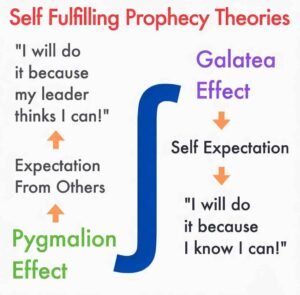
The Galatea Effect: When Self-Expectations Become Reality
Imagine sculpting your own success like the mythical Galatea, brought to life by belief alone. The Galatea Effect refers to the phenomenon where an individual’s high self-expectations lead to improved performance. Coined in psychological literature, it’s essentially a self-fulfilling prophecy driven from within. Unlike external influences, this effect hinges on your internal dialogue, believing you’re capable boosts motivation and output.
Studies on the Galatea Effect often tie it to workplace and educational settings. For instance, research has shown that raising self-expectations in volunteers increased their participation by enhancing self-efficacy, the belief in one’s ability to succeed. In a field experiment, interventions that bolstered self-efficacy led to temporary performance gains, highlighting boundary conditions like sustained motivation. Another study generalized the effect beyond the Pygmalion framework, showing how self-expectations influence broader performance metrics in psychology.
Why does this matter? If you don’t know about these studies, you might not realize how tweaking your self-talk can create upward spirals. Children, for example, thrive under the Galatea Effect when their self-belief shapes learning outcomes.
The takeaway: Start affirming your potential, and watch your actions align.
Rosenthal’s 1968 Study: The Pygmalion Effect in Action
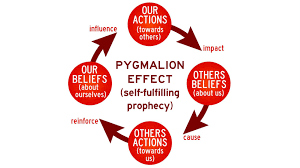
Flash back to 1968 in California, where psychologist Robert Rosenthal conducted a landmark experiment at an elementary school. Known as “Pygmalion in the Classroom,” this study demonstrated how teacher expectations could dramatically influence student performance. Rosenthal and Lenore Jacobson randomly labeled some students as “intellectual bloomers” based on a fake IQ test, telling teachers these kids were poised for growth.
The results? Those students showed significant IQ gains, especially in younger grades, proving that high expectations from authority figures can become self-fulfilling prophecies. However, the study faced criticism for methodological flaws and replicability issues. Despite this, it sparked decades of research on the Pygmalion Effect, where positive expectations enhance outcomes in education and management.
This experiment underscores a key reason for low self-regard: If external validations are missing or negative, internal belief suffers. Rosenthal’s work reminds us that perceptions—yours or others’—shape reality.
Van Dinther’s Research: Boosting Self-Efficacy in Higher Education
Mart van Dinther’s work focuses on how educational environments foster self-efficacy, particularly in competence-based learning. In a 2011 review, van Dinther and colleagues analyzed factors affecting students’ self-efficacy in higher education, finding that mastery experiences, social modeling, and verbal persuasion play crucial roles. Their research question: What elements in learning settings enhance or hinder self-belief?
One study examined student teachers, showing that assessment experiences in competence-based programs significantly build self-efficacy. Another explored perceptions of assessment, revealing that positive feedback loops increase efficacy and performance. Van Dinther’s findings emphasize that self-efficacy isn’t innate, it’s cultivated through structured experiences, making it vital for educators to design empowering curricula.
If you haven’t encountered this research, you might overlook how everyday learning interactions erode or build your confidence. It’s a call to seek environments that affirm your growth.
The Book “Self-Efficacy: The Exercise of Control” by Albert Bandura
Published in 1997, Albert Bandura’s seminal book Self-Efficacy: The Exercise of Control is the definitive guide to understanding how beliefs in our capabilities drive behavior. Spanning over 600 pages, it compiles two decades of research, explaining how self-efficacy influences motivation, resilience, and achievement across domains like health, education, and work.
Bandura argues that perceiving control over outcomes leads to healthier, more effective lives. The book delves into sources of self-efficacy, mastery experiences, vicarious learning, persuasion, and emotional states, offering practical insights for personal development. It’s not just theory; it’s a blueprint for exercising agency in changing societies.
Skipping this read means missing the toolkit for self-empowerment. Bandura’s work shows that self-doubt often stems from unexamined beliefs.
What Self-Efficacy Really Means
At its core, self-efficacy is your belief in your ability to organize and execute actions needed to achieve specific goals. Introduced by Albert Bandura in 1977, it’s not about innate talent but perceived competence in facing challenges.
Unlike general confidence, self-efficacy is task-specific, high in one area (e.g., public speaking) doesn’t guarantee it in another (e.g., math). It predicts motivation, learning, and resilience: People with strong self-efficacy tackle difficulties head-on, while low efficacy leads to avoidance. Understanding this concept is foundational, without it, self-doubt feels like fate rather than a changeable belief.
Who Is Albert Bandura?

Albert Bandura (1925–2021) was a Canadian-American psychologist whose work revolutionized social cognitive theory. A Stanford professor, he’s best known for the Bobo doll experiments on observational learning and originating concepts like self-efficacy.
Bandura emphasized human agency—our capacity to influence our lives through beliefs and actions. Awarded the National Medal of Science, his influence rivals Freud and Skinner. Knowing Bandura means grasping that behavior isn’t just conditioned, it’s shaped by how we perceive our power.
Pajares on Misunderstandings of Self-Efficacy Constructs
Frank Pajares highlighted common pitfalls in measuring and interpreting self-efficacy. In his 1996 review, he clarified that self-efficacy differs from other expectancy beliefs, it’s about perceived capability, not outcome predictions. Misunderstandings often lead to flawed assessments, like confusing it with self-concept or locus of control.
Pajares’s work on writing motivation showed self-efficacy correlates strongly with achievement, but only when properly measured. He urged researchers to use domain-specific scales to avoid confounding results. Without this nuance, you might misapply self-efficacy, perpetuating low self-regard through inaccurate self-assessments.
RAS: The Reticular Activating System and Your Mental Filter
RAS stands for Reticular Activating System, (check my article about the RAS clicking Here) a brainstem network that filters sensory input based on your beliefs and focus. It acts as a gatekeeper, deciding what reaches your conscious awareness, aligning reality with your expectations.
In psychology, RAS explains why positive self-belief attracts opportunities: It highlights confirming evidence while ignoring contradictions. Low self-regard? RAS amplifies negatives, creating a cycle of doubt. Reprogramming it through affirmations can shift your mindset, boosting confidence and esteem.
Ozer’s 1990 Analysis: Empowerment Through Self-Efficacy
In 1990, Elizabeth Ozer and Albert Bandura analyzed how self-efficacy mediates empowerment effects. Their experiment showed that perceived coping and cognitive control govern responses to threats, like physical stressors.
Findings revealed that empowerment strategies enhance resilience by building self-efficacy, reducing anxiety and improving performance. This work has implications for health and youth programs, where empowerment fosters agency. Ignoring it means missing how internal mechanisms turn empowerment into tangible gains.
Cervone’s 1986 Discovery: Self-Reactive Influences on Motivation
Daniel Cervone, collaborating with Bandura, discovered in 1986 that self-reactive influences, like self-evaluation, differentially affect motivation based on goal discrepancies. Their study found that when performance falls short, self-reactions (e.g., dissatisfaction) spur greater effort, but only up to a point.
This highlights self-regulation’s role: Positive discrepancies motivate persistence, while extreme gaps can demotivate. Cervone’s insights explain why low self-belief leads to giving up, unaddressed self-reactions perpetuate cycles of underachievement.
Maddux’s 1995 Proposal: The Power of Imaginal Experiences
James Maddux proposed in 1995 that “imaginal experiences”, mental visualization, serve as a fifth source of self-efficacy, beyond Bandura’s four. By vividly imagining success, individuals boost belief in their capabilities, influencing behavior change.
This addition has been applied in sports and therapy, where visualization enhances performance. Maddux’s idea shows that mental rehearsals can rewire self-doubt, making it a practical tool for building efficacy.
The Golem Effect: Measuring the Cost of Low Expectations
The Golem Effect measures how low expectations, from others or yourself, lead to diminished performance. Opposite the Pygmalion Effect, it creates downward spirals: Supervisors’ biases cause subordinates to underperform, reinforcing the cycle.
Studies show it in workplaces and groups, where implicit theories erode motivation. It quantifies lost potential: Low self-view stifles growth, often subtly through self-fulfilling behaviors. Recognizing it helps break free, challenge those expectations to reclaim your power.
Beyond the Iceberg: Building a Stronger Self-View
These concepts reveal a truth: Your self-worth isn’t fixed; it’s shaped by beliefs, expectations, and filters like RAS. By exploring Bandura’s world, effects like Galatea and Golem, and researchers like Van Dinther and Maddux, you arm yourself against doubt. Start small, read Bandura’s book, visualize success, question low expectations. The rabbit holes are endless, but the reward? A life where you finally think highly enough of yourself to thrive. What’s your first step?

MEET COACH G.
I help individuals like you reprogram your mind, break free from subconscious limitations, and expand your awareness to create lasting transformation. Your consciousness shapes your reality—when you shift your perception, you unlock new levels of success, resilience, and fulfillment effortlessly. Blending Quantum Psychology, Ancient Wisdom, and cutting-edge neuroscience, I guide you through deep transformation—helping you dissolve mental barriers, rewire old patterns, and step into a life of clarity and limitless potential. Based in Dubai & available online, I’m here to help you harness the power of your mind and reshape your reality.