

December 28, 2025
Coach G
No Comments
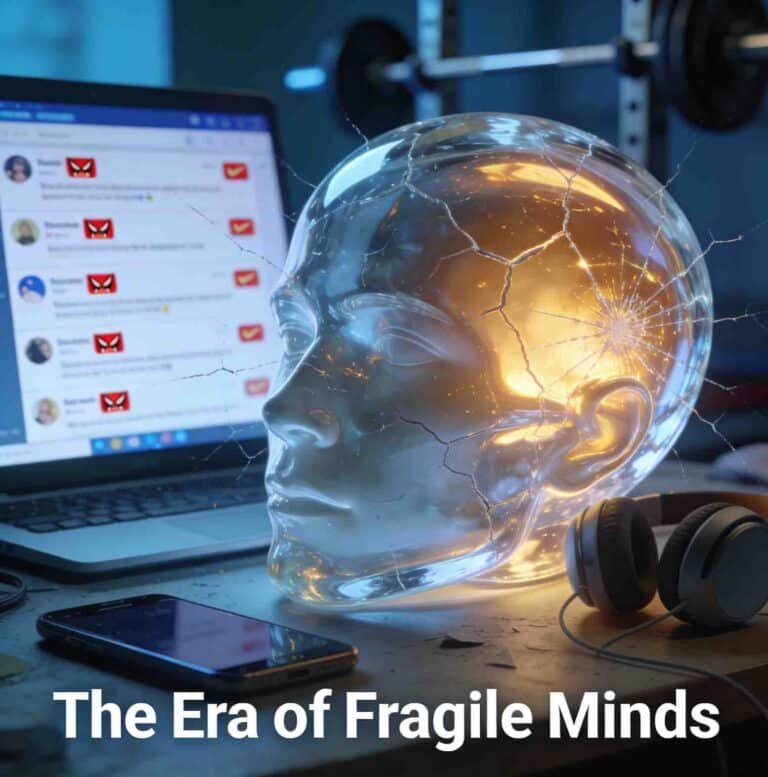
How entitlement, outrage culture, and the death of discipline are eroding emotional resilience… And what it really takes to grow up in a world that doesn’t care about your feelings.
We’re Not Built Like We Used To Be
We are living in a time where people break under pressures that previous generations pushed through without a second thought. Normal life friction is rebranded as trauma. Being called out is “abuse.” Accountability is “attack.” Anyone who disagrees becomes the villain in someone’s story and gets cancelled privately or publicly.
Meanwhile:
- Discipline is rare.
- Respect is nearly extinct.
- Entitlement has become the new norm.
Emotional resilience, the capacity to be hit by life and not shatter or explode, is no longer common. Instead, everything and everyone “triggers” everyone and every-one.
This isn’t just nostalgia, like my son would comfortably claim it is because of my growing age. Studies increasingly show that younger generations are more psychologically vulnerable, with higher rates of anxiety, depression, and maladaptive coping, while older cohorts generally show more resilience and flexibility under stress.
So what happened?
From Discomfort to “Trauma”: When Language Weakens Us
Trauma is real. Abuse is real. But there is a growing cultural habit of labeling normal discomfort as traumatic, which has consequences.
- A difficult conversation becomes “emotional abuse.”
- A firm boundary becomes “toxicity.”
- A critical comment becomes “unsafe.”
When we catastrophize everyday stressors and over-pathologize normal emotional pain, we actually decrease resilience. When everything is trauma, nothing is. The nervous system stops learning the difference between “this is uncomfortable” and “this is genuinely dangerous.”
Previous generations didn’t have this luxury of linguistic inflation. The Silent Generation and Baby Boomers lived through war, economic instability, and scarcity; stoicism and emotional control were survival tools. Today, many have grown up with unprecedented material comfort, constant entertainment, and the ability to opt out of discomfort with a swipe or a tap.
Comfort is not evil. But chronic over-comfort weakens the emotional immune system. Oh… and Selfishness… But this is another topic…
The Entitlement Epidemic: Why Everything Feels “Unfair”
Entitlement tells you: “I deserve ease. I deserve validation. I deserve immediate results.” When reality does not match that expectation, arisen from your little “I“, the gap shows up as outrage, anxiety, or collapse.
When normal obstacles are interpreted as deep injustice, the response becomes resentment instead of responsibility.
Drivers of this mindset include:
- Instant gratification culture: Two-day shipping, on-demand streaming, and answers in seconds condition us to expect everything now.
- Social media distortion: Everyone’s highlight reel creates a fantasy where success looks effortless. Struggle feels like proof that something is wrong with you, or with the world.
- Shifting values: In many spaces, hard work, sacrifice, and perseverance have been replaced with an overemphasis on comfort, self-expression, and constant emotional validation.
When entitlement meets resistance, the story quickly becomes: “I’m being oppressed,” not “I’m being challenged.” Instead of asking “How do I grow through this?” the reflex becomes “Who can I blame for this?”
Outrage, Projections, and the Cancel-Button World
Anger and outrage have always existed, but social media has turned them into a performance sport. Posts with moral-emotional language, especially anger and disgust, spread faster and farther online. Algorithms reward moral outrage. The more shocked and offended you appear, the more attention you get. People make more money on rage-bait than on actual information and useful content…
That creates a few problems:
- Moral outrage becomes social currency. Being offended signals virtue and belonging to the “right” side.
- Context vanishes. A clumsy joke can be punished like a deliberate act of harm.
- No room for growth. Cancel culture started as a demand for accountability but is increasingly a mechanism of fear, shame, and erasure, leaving little space for apology, repair, or evolution.
This culture trains people to:
- Externalize blame.
- See disagreement as attack.
- Live in constant fear of being next.
The result? Less honest dialogue, more self-censorship, and a pervasive sense that the world is unsafe—not because of physical threat, but because of reputational fragility.
The Death of Respect and the Rise of the Thin Skin
Respect is becoming a lost art. Educators, leaders, and therapists increasingly note a general decline in accountability and an increase in selfishness and entitlement. The “other” becomes an abstraction: a target, an obstacle, or a prop in our self-story.
When emotional intelligence shifts from “regulate yourself” to “everyone else must walk on eggshells,” three things happen:
- Boundaries are demonized as rejection.
- Authority is always oppressive, never protective.
- Any form of honest feedback becomes “harm.”
Expression without resilience is volatility.
The Real World Does Not Care About Your Feelings
Here is the brutal truth that almost no one wants to hear: the real world does not exist to validate your emotions. Sorry… Not sorry.
The market does not care how you feel about your bank balance. It doesn’t care if your blew up your trading account on buying the greatest meme-coin of if Bitcoin is moving high or low… You might care though, but trust me the market doesn’t. Gravity does not care how you feel about falling. Illness does not care how you feel about your health. Even love, the real kind, will not protect you from discomfort; it will often expose you to more of it, and call you on your BS as much as needed !
Previous generations, for all their blind spots, understood this at a visceral level. There was less talk of “processing” and more raw necessity: you showed up to work, you raised your kids, you pushed through pain because there was no other option. Emotional resilience wasn’t philosophy, it was survival, it was Life.
Today, with more freedom, choice, and comfort, we have accidentally turned that freedom into fragility. We don’t just feel pain; we personalize it, story it, broadcast it, and often build an identity around it.
The world still functions on the old rules:
reality > feelings. (Your illusion will claim the opposite).
The person who can tolerate being uncomfortable will always outrun the one who needs to be constantly emotionally padded.
Accountability Is Not Abuse
One of the most damaging confusions of our time is the equation:
Accountability = Attack
Disagreement = Harm
Firmness = Violence
Accountability is not abuse. It is reality rubbing against your ego. It asks:
- “What is my part in this?”
- “What can I change?”
- “What am I refusing to take responsibility for?”
When every call to responsibility is labeled “shaming,” growth dies. You cannot build resilience if nobody is allowed to tell you the truth.
This doesn’t mean tolerating genuine harm or injustice. It means relearning the difference between:
- Being corrected vs being crushed.
- Being challenged vs being dehumanized.
- Being uncomfortable vs being unsafe.
Without that discernment, everything becomes a trigger, and nothing or noone becomes a teacher.
How We Got Here (And Why It’s Not All Bad)
It’s important to acknowledge why this shift happened:
- Previous generations often suppressed emotion to a damaging degree, trauma went unspoken, abuse was normalized, mental health ignored.
- The current wave of mental health awareness, therapy, and emotional language is in many ways a necessary corrective.
- Marginalized voices finally have platforms, and calling out genuine harm is crucial.
The problem is the pendulum swing: from “shut up and cope” to “I’m fragile and everyone else must adapt.” One extreme dehumanizes; the other infantilizes.
The sweet spot is inner strength with emotional honesty.
What Real Resilience Actually Looks Like
Real emotional resilience is not numbness. It’s the ability to:
- Feel deeply without being ruled by feelings.
- Stand in discomfort without collapsing.
- Hear hard truth without exploding or imploding.
- Own your part without drowning in shame.
Resilience is built, not inherited, through exposure to manageable stress, supportive relationships, and meaning-making. Remove all friction, and you remove the training ground.
How to Grow a Spine in the World
A few core practices:
- Reframe discomfort as training, not threat.
Ask in every challenge: “What is this here to build in me?” - Choose responsibility over blame.
Shift from “Why is this happening to me?” to “How am I showing up in this?” - Strengthen your nervous system, not just your narrative.
Sleep, movement, breathwork, gym, cold exposure, body-first resilience feeds emotional toughness. - Practice clean conflict.
Learn to disagree without dehumanizing. Hold your line without needing the other person to be evil. - Fast from outrage.
Take breaks from moral drama. Audit your social feeds. Notice how often you’re pulled into problems that are not yours to solve. - Surround yourself with people who won’t baby you.
Mentors, coaches, friends who can say, “Yes, it hurts, and you’re capable of more.”
A Call to the Few Who Are Done Being Fragile
Most people will keep scrolling, keep raging, keep externalizing. That’s the default setting.
This is for the ones who are secretly tired of being so easily thrown off. The ones who are done letting algorithms, trends, and collective moods dictate their inner state. The ones who are ready to stop outsourcing power and start building a life.
The world ahead is not getting softer. It is getting faster, noisier, and more demanding. You can either keep asking it to cuddle you, and it will not, or you can become someone who can stand in the raw, uncomfortable Real without collapsing.
If there is one through-line to every previous generation that survived worse conditions with fewer tools, it is this: they didn’t have the option to opt out. They had to adapt, grow, and carry on.
So the question becomes:
Are you going to be the generation that collapses under notifications and opinions, or the one that remembers how to be human under pressure?
Because no matter how loud the noise gets out there, the real work is still in here: inside your nervous system, your mindset, your habits, your willingness to face yourself.
That’s where resilience is built. That’s where entitlement dies. That’s where respect is reborn, starting with self-respect.
And that’s exactly where the real world begins.
Share:
Categories
Popular Posts

How to Unfuck Your Life in 5 Minutes
September 5, 2026

The Secret Was Incomplete, here are the missing keys.
September 4, 2026

Michelangelo Never Named It “The Creation of Adam.” Salesmen Did.
September 4, 2026
Tags
Book Summary
Coach G
Coaching
consciousness
ego
Emotional Healing
Emotional Intelligence
Emotional Resilience
empowerment
faith
forgiveness
Growth Mindset
healing
Inner Peace
law of attraction
letting go
life coach
life coach Dubai
Life Coaching
Life Coaching Dubai
Manifestation
marriage
Mental Health
Mindfulness
Mindset Shift
oneness
Personal Development
personal growth
Personal Transformation
Positive Mindset
productivity
quantum psychology
relationships
Resilience
Self-Awareness
Self-Discovery
Self-Improvement
Spiritual Awakening
spiritual coach
spiritual growth
spirituality
Success Mindset
Time Management
Transformation
Universal Laws
© 2026 Coach G Dubai. All rights reserved.


